
From Stitch Removal to Long-Term Healing
One of the most common questions patients ask after abdominal liposuction is:
“Is it normal for my incision to look red or slightly open after stitches are removed?”
This concern is especially common among international patients who return home shortly after surgery and have their stitches removed about two weeks later.
To answer this honestly and clearly, it is important to understand that liposuction scars change over time.
Early Healing Stage: After Stitch Removal
After stitches are removed, some patients notice that the small liposuction incision:
- Looks slightly open
- Has a small scab
- Appears red or more visible than expected
This often causes worry, but in most cases, this appearance is not an infection or a complication.
Why does this happen?
The abdomen is constantly moving. Simple daily actions such as sitting, standing, bending, or walking place tension on the skin.
When stitches are removed:
- The external support holding the skin together is gone
- The deeper tissue is still strengthening
As a result, a very small opening (called micro-dehiscence) can occur. The body responds by forming healthy healing tissue and a temporary scab.
As long as there is:
- No pus
- No increasing pain
- No spreading redness or heat
this stage is usually part of normal wound healing.
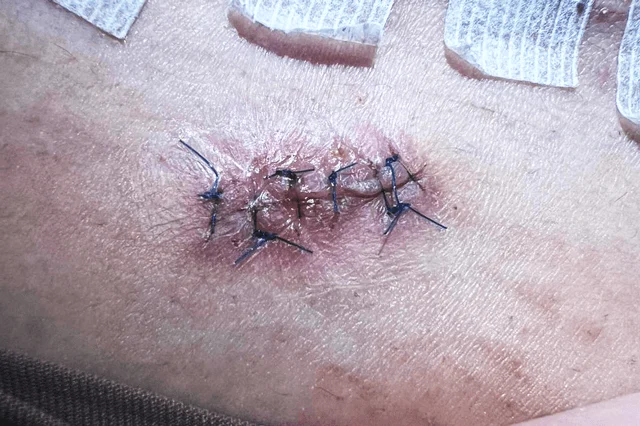
Before_Stich_out
Before stitch removal: Early healing stage with stitches and scabbing visible.
What Matters Most at This Stage
At this point, the goal is not additional treatment, but proper wound support.
At Evita Clinic, patients are guided to:
- Confirm the timing of stitch removal through photo review when possible
- Use Steri-Strips after stitch removal to reduce skin tension
- Avoid friction, excessive movement, or early massage
These steps help prevent the incision from widening and support better long-term scar quality.
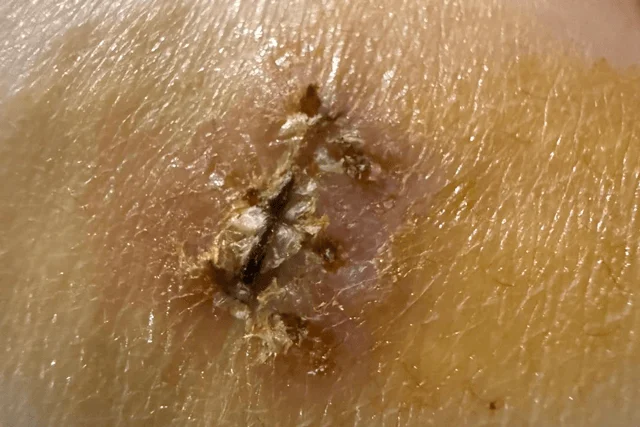
after_stich_out
After stitch removal: Immediately after removal, showing stable early wound healing.
Long-Term Result: Years After Liposuction
Now compare the early healing image with this photo, taken three years after abdominal liposuction.
In most patients:
- Small incisions gradually fade
- Redness resolves
- Scars become subtle and difficult to notice
This long-term outcome is what truly matters — and it is rarely represented by early healing photos alone.
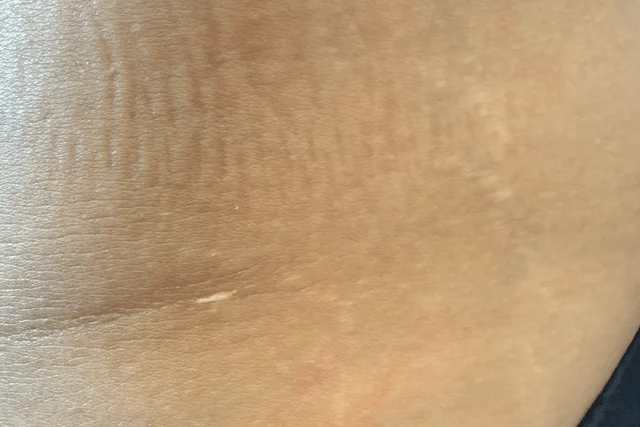
Noraml_liposcution_scar
Abdominal liposuction scar, 3 years after surgery In most patients, small incisions fade naturally over time with proper care.
Why Early Appearance Does Not Predict Final Scars
A common misunderstanding is believing that:
“If it looks bad now, it will look bad forever.”
In reality, early wound appearance does not determine the final result.
With:
- Proper timing of stitch removal
- Correct use of Steri-Strips
- Step-by-step scar care after wound stabilization
most liposuction scars improve significantly over time.
A Rare but Understandable Healing Variation
In rare cases, an incision may look more concerning after stitch removal.
The wound may appear:
- More open than expected
- Red with a thicker scab
- Slower to stabilize, even without signs of infection
This usually occurs when skin tension is high, the incision is located in a frequently moving area, or the skin needs more time to regain strength after stitches are removed.
Although this appearance can be alarming, it is uncommon and, in most cases, temporary when managed properly.
Even in these situations, with appropriate wound support and scar care, the incision typically continues to heal and gradually settles into a normal, subtle scar over time.
Early appearance does not predict the final long-term result.
This is exactly why careful timing of stitch removal and structured wound support afterward are so important.
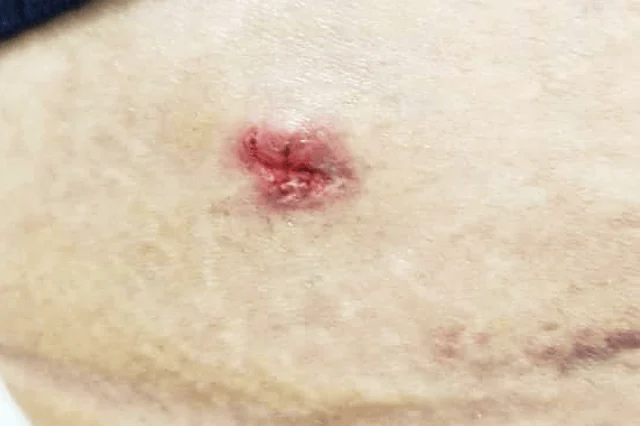
after_liposuction_wound_problem
This image shows a normal healing variation after stitch removal. It does NOT represent infection or a surgical complication.
Evita Clinic’s Approach to Post-Liposuction Scar Care
For international patients in particular, Evita Clinic provides structured guidance beyond surgery itself:
- Photo-based wound checks before stitch removal
- Clear instructions for Steri-Strip use after removal
- Scar ointment guidance once the incision is fully stable
Because liposuction is not complete when the surgery ends. Healing, support, and long-term care are all part of the treatment.
A Simple Takeaway
If your incision looks red or slightly open shortly after stitch removal:
- It is often temporary
- It is usually related to skin tension, not infection
- And it does not represent your final result
What matters most is how the incision is supported during healing — and how it is cared for over time.
When you understand the healing process, the recovery becomes far less stressful. And with proper care, liposuction scars usually fade quietly into the background.


![[FAQ] Can I Have Gynecomastia Surgery and Abdominal Liposuction at the Same Time?](https://evitaclinic.com/wp-content/uploads/2025/07/gyn_tummy_same-500x383.webp)


![[FAQ] Post-Surgical Compensatory Hyperhidrosis](https://evitaclinic.com/wp-content/uploads/2025/04/compensatory_hyperhidrosis_01-500x383.webp)