Gynecomastia Recovery Guide
Steri-Strips are the simplest tool available for protecting a healing chest incision — and the one most often stopped too early. This guide explains what they do, why Evita Clinic asks for roughly two months rather than the usual five to seven days, and exactly how to apply them.
Written by Dr. Francis Jeon, MD, board-certified thoracic and cardiovascular surgeon, Evita Clinic, Seoul. Last updated: July 2026.
Key Points
- How long: Keep Steri-Strips on your chest for about two months after gynecomastia surgery — not the conventional 5–7 days.
- Why: A scar reaches only a fraction of normal skin strength by the time sutures come out, and stays mechanically fragile for two to three months.
- The risk: Tension during that window causes hypertrophic scars (raised and thickened) or stretched scars (widened into a pale band). Both are permanent; both are largely preventable.
- Why the chest: The chest — with the shoulders, neck, upper back, elbows and knees — is a high-tension area. A gynecomastia incision is pulled every time you raise an arm or contract the pectoral muscle.
- Replacement: Change the strips every 5–7 days, or when they loosen. Do not change them daily.
Scarring After Incision Surgery
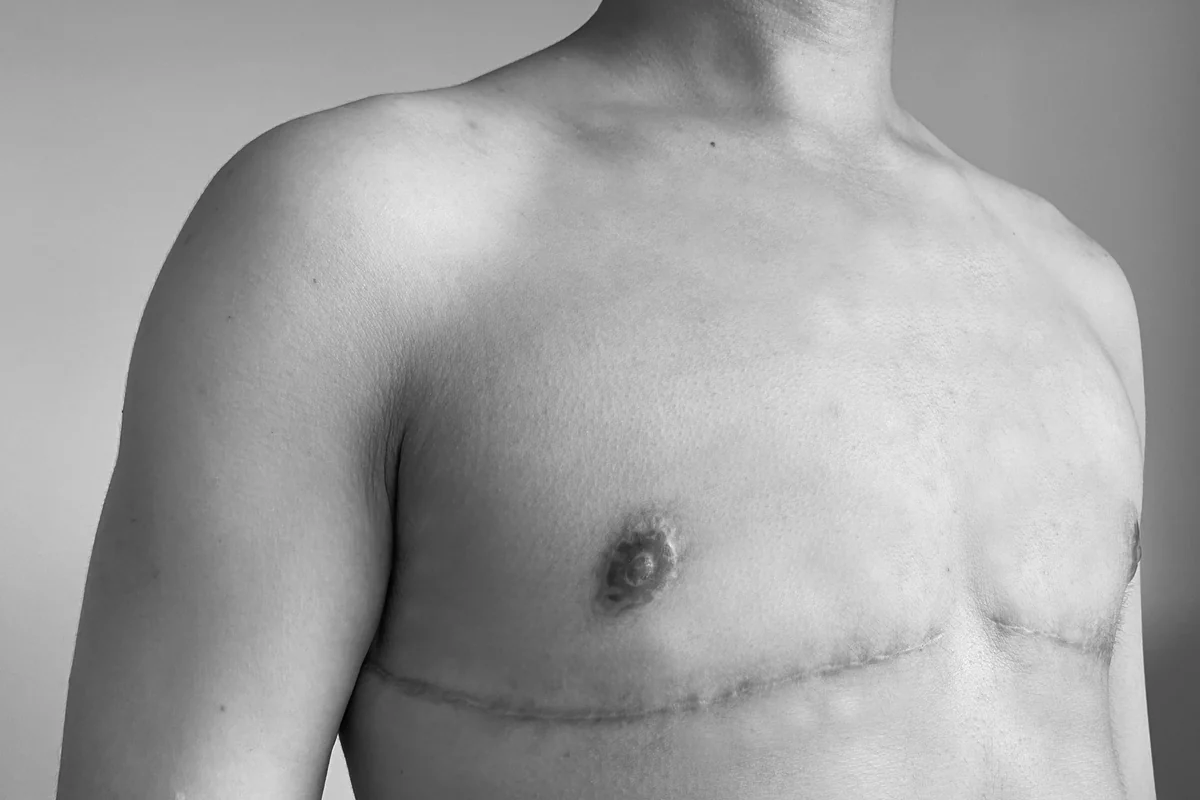
A typical, well-healed gynecomastia scar.
Whenever surgery involves an incision, scarring cannot be avoided completely. Even when the same technique, the same materials and the same suture method are used, the final scar differs from person to person.
Scars normally fade and flatten over time — but how far they fade depends heavily on how the wound is cared for during the first few months.
Scars that did not heal as well as they could have.
After your sutures are removed, Evita Clinic recommends continuing Steri-Strips for an extended period — at least two months — to keep tension off the healing skin.
What Are Steri-Strips?
Steri-Strips are narrow, medical-grade adhesive tapes that hold the edges of a surgical incision together after the sutures have been removed. They adhere far more strongly than an ordinary bandage, and their porous backing lets the wound breathe.
A supplement to sutures, not a replacement
Sutures or staples provide the primary closure immediately after surgery. Steri-Strips are applied after suture removal — and sometimes alongside sutures — to keep supporting the wound and to take mechanical tension off the healing skin.
Evita Clinic prescribes 3M Steri-Strips, 4 inches (10 cm) long, which are cut into shorter segments before use.
Why Are Steri-Strips Used After Gynecomastia Surgery?
Steri-Strips are used after gynecomastia surgery for three reasons: they hold securely while still flexing with body movement, they allow the wound to breathe, and — most importantly — they stabilize the wound edges so the scar cannot widen.
Strong Hold, With Flexibility
They grip better than ordinary medical tape while still flexing with normal body movement, so the incision is not stressed every time you move.
Breathable
The porous backing allows air circulation, which supports a healthier healing environment than an occlusive tape.
They Limit Scar Widening
By stabilizing the wound edges, Steri-Strips prevent the scar from stretching wider than it needs to. This is the single most important factor in whether a chest scar ends up as a thin line or a broad band.
Why Two Months? Tension, Hypertrophic Scars, and Scar Widening
Most patients are told to keep Steri-Strips on for five to seven days after suture removal. Evita Clinic asks for considerably longer — approximately two months — because that is how long a chest scar stays vulnerable to mechanical tension. Here is the reasoning.
A fresh scar is weak for far longer than it looks
Skin closure is not the same as skin strength. At the time sutures come out, the wound has only a small fraction of the tensile strength of normal skin. Strength then builds gradually as collagen is deposited and remodeled, and it does not approach a durable level until roughly two to three months after surgery.
This creates a gap: the incision looks closed at two weeks, but mechanically it is still fragile. Steri-Strips are there to cover that gap.
Tension is what turns a good scar into a bad one
During this same period the scar is at its most reactive. Sustained mechanical tension on the wound edges keeps the fibroblasts within the scar activated, and they respond by laying down excess collagen. Depending on how the pull is applied, the result goes one of two ways.
| Scar type | What it looks like | What causes it |
|---|---|---|
| Hypertrophic scar | Raised, thickened, red and firm — but stays within the original incision line | Sustained tension driving excess collagen deposition |
| Stretched (widened) scar | A fine line spreads into a wide, pale, flat band | Wound edges pulled apart before the scar gains strength |
Both are largely preventable, and both are driven by the same thing: tension during the first months of healing. Steri-Strips work by transferring that tension from the delicate wound edges to the surrounding intact skin.
The chest is one of the worst areas for tension
Scars do not behave the same way everywhere on the body. Certain regions are known for tension-related scarring, and the chest is at the top of that list — along with the shoulders, the neck, the upper back, and joints such as the elbows and knees. What these areas share is constant motion and constant pull on the skin.
A gynecomastia incision sits squarely in this zone. Every time you raise your arm, reach forward, pull a shirt over your head or contract the pectoral muscle, the skin over the chest moves and the scar is loaded. Add to that the fact that male chest skin is relatively thick and under baseline tension, and the incision is being tugged dozens of times a day — usually without you noticing.
This is exactly why a scar on the abdomen may settle beautifully while the same technique on the chest produces a thickened line. It is not the surgery that differs. It is the mechanical environment.
What two months of taping accomplishes
Keeping Steri-Strips on through this window means the scar spends its most vulnerable phase mechanically supported and offloaded. The result is a narrower, flatter, paler scar — and a much lower chance of hypertrophic scarring.
Two months of taping is a small inconvenience. A widened or raised chest scar is permanent, and revising one is far harder than preventing it.
How Long to Keep Steri-Strips On
Sutures are removed 7–14 days after gynecomastia surgery. Steri-Strips are then applied and kept in place for approximately two months, with a fresh set every 5–7 days.
| Stage | Timing |
|---|---|
| Suture removal | 7–14 days after surgery |
| Steri-Strips applied | Immediately after suture removal |
| Replace with a fresh set | Every 5–7 days, or when they loosen |
| Stop taping | Approximately 2 months |
The exact timing depends on your surgeon’s assessment and how quickly you heal. Evita Clinic will guide you on the right time for suture removal and how long to extend Steri-Strip use, based on your individual healing.
Replacing them
Steri-Strips are not meant to be changed daily. Leave them in place until they loosen or become worn — typically every 5–7 days — then replace them with a fresh set.
When an edge starts to lift
Do not pull a lifting strip off. Apply a fresh Steri-Strip over the loose section, in the same direction, for added support.
When to remove one immediately
If you see moisture or blood underneath a strip, or if the wound looks open, remove that strip right away. Take a photo and send it to us — Dr. Francis Jeon will review the wound and advise you on what to do next.
International patients: if you have already traveled home after surgery, send us photos of your incision. We can advise whether it is safe to remove your sutures and how to continue with Steri-Strips.
How to Apply Steri-Strips: Step by Step
Cut each 4-inch Steri-Strip into roughly one-inch segments and apply them perpendicular to the incision, spaced slightly apart. Two or three strips per side are enough for a gynecomastia incision.
The Product
Steri-Strips by 3M, prescribed at our clinic after gynecomastia surgery.
Wash Your Hands
Wash your hands and open the packaging once they are dry.
Check the Length
The Steri-Strip we prescribe is 4 inches (10 cm) long.
Cut It in Half
First, cut it in half with clean scissors.
Cut It Again
Cut each half again.
One Inch Each
One inch per piece is enough.
Peel the Backing
Peel off the paper backing so you can lift the strips one by one.
Apply at 90°
Use tweezers or a clean hand to apply each strip perpendicular to the incision.
Leave a Gap
The wound needs to breathe, so space the strips apart — do not overlap them.
Two or Three Per Side
For a gynecomastia incision, two or three strips per side are sufficient.
Press Down Firmly
Press down with your palm for a few seconds so the strips adhere firmly.
Watch: How to Apply Steri-Strips
Evita Clinic’s demonstration showing the correct way to apply Steri-Strips after gynecomastia surgery.
How to Remove Steri-Strips Safely
Soften the adhesive with warm water first, then peel each strip away slowly and parallel to the skin. Removing a Steri-Strip too quickly or too forcefully can lift newly formed skin and set healing back.
- Soften the adhesive first. Wet the area with warm water or mild soap to loosen the glue.
- Go slowly. Peel the strip away gradually, flat against the skin rather than straight up, so you do not lift new skin or scabs with it.
Common Mistakes
- Applying parallel to the incision. The strips must cross the incision at a right angle to offload tension.
- Stopping at one week. This is the most common mistake, and the reason many chest scars widen after an otherwise good result.
- Stretching the strips tightly. Excessive tension may cause redness, irritation or blistering.
- Replacing them daily. Frequent removal damages healing skin.
- Applying to wet skin. Moisture reduces adhesion and increases irritation.
Additional Wound Care After Gynecomastia Surgery
- Check your incision daily. Watch for redness, swelling, increasing pain, bleeding or unusual discharge, and contact us if anything concerns you.
- Keep it clean and dry. After showering, pat the incision dry and apply any antiseptic or ointment we have recommended.
- Avoid strenuous activity. No heavy lifting or intense exercise until cleared. Sudden or forceful movement is precisely the tension the Steri-Strips are there to prevent.
- Protect the scar from sun. A healing scar pigments easily. Keep it covered, or use sunscreen once the wound is fully closed.
- Attend your follow-ups. Regular review lets us track your healing and address problems early, while they are still easy to correct.
Frequently Asked Questions
How long should I wear Steri-Strips after gynecomastia surgery?
About two months. Conventional advice is 5–7 days after suture removal, but the chest is a high-tension area and a scar does not regain meaningful strength until two to three months after surgery. Evita Clinic asks patients to keep taping through that entire window, replacing the strips every 5–7 days.
Why does the chest scar worse than other parts of the body?
Because of mechanical tension. The chest, shoulders, neck, upper back, elbows and knees all move constantly and keep the skin under pull. A gynecomastia incision is loaded every time you raise an arm, reach forward or contract the pectoral muscle. The same surgical technique that leaves a fine line on the abdomen can produce a thickened scar on the chest purely because of that difference.
Can I shower with Steri-Strips on?
Yes, once your surgeon has cleared you to shower. Do not soak or scrub the strips. Afterwards, pat the area dry rather than rubbing it, and let it air-dry fully before dressing. Do not submerge the area in a bath, pool or hot tub until you have been cleared.
How often should Steri-Strips be changed?
Every 5–7 days, or whenever they loosen or become worn. They are not designed for daily replacement — changing them too often irritates the skin and defeats the purpose.
What if a Steri-Strip falls off early?
Replace it. Apply a fresh strip in the same direction, perpendicular to the incision. The goal is continuous support across the scar, so a gap of a day or two is worth correcting.
What if the corner of a Steri-Strip starts peeling up?
Do not pull it off. Apply a new Steri-Strip over the lifting section, in the same direction, to reinforce it. Forcibly removing a partially adhered strip can tear newly formed skin.
Do Steri-Strips actually prevent scarring?
They do not prevent a scar — any incision leaves one. What they do is reduce how bad that scar becomes, by holding the wound edges together and offloading tension onto the surrounding skin. That is what determines whether the final result is a thin line or a widened, raised band.
Can I use ordinary medical tape instead of Steri-Strips?
It is not equivalent. Steri-Strips are designed to hold wound edges under tension while remaining porous. Ordinary tape either lacks the necessary adhesion or seals the wound off from air. Generic wound closure strips or skin closure tapes work similarly and are an acceptable substitute if original Steri-Strips are unavailable.
What if my skin becomes red or itchy under the strips?
Mild itching during healing is common. But spreading redness, a rash, blistering or persistent irritation may indicate an adhesive reaction. Remove the strips, photograph the area and contact us — there are alternatives we can suggest.
Does removing Steri-Strips hurt?
It should not, if you soften the adhesive with warm water first and peel slowly, keeping the strip flat against the skin rather than pulling straight up. Pain usually means you are going too fast.
When can I start silicone gel or scar gel?
After Steri-Strip therapy is finished, not during it. Scar gels, ointments and silicone products leave a thin film on the skin that prevents the strips from adhering and causes them to detach early. Complete the taping period first, then begin scar gel.
When can I return to the gym?
Only after your surgeon clears you. Heavy lifting, pushing and pressing movements load the chest directly and apply exactly the kind of tension that widens a scar. Returning early is one of the most common reasons a well-executed gynecomastia scar ends up looking poor.
I live abroad and cannot come back for follow-up. What should I do?
Send us photographs of your incision. Evita Clinic routinely follows international patients remotely — Dr. Jeon will assess the wound, advise on suture removal timing, and guide you through the taping period. Contact us here.
When Should I Contact Evita Clinic?
- Increasing redness around the incision
- Wound separation, or an open area beneath a strip
- Moisture, blood, pus or foul-smelling drainage
- Persistent itching, rash or blistering
- Suspected adhesive allergy
- Any concern about how the incision is healing
Important Note
Steri-Strips are one of the most cost-effective scar management tools available. Although simple, they remain widely used by plastic surgeons worldwide because reducing tension is one of the most important factors in achieving a fine scar.
Every scar heals differently. Final scar appearance depends on many factors including skin type, genetics, surgical technique and postoperative care. This guide is general information and does not replace the instructions given to you by your own surgeon.
Questions About Your Recovery?
If you have any question about Steri-Strips, scar care, skin irritation or wound healing, message us directly using the buttons below. Dr. Francis Jeon reviews patient photos personally.