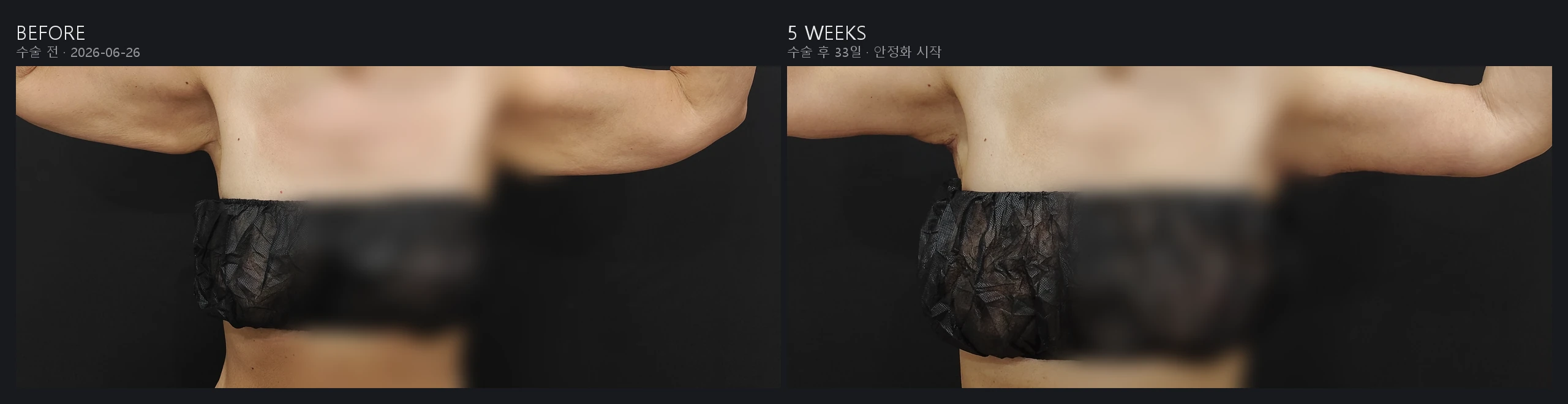
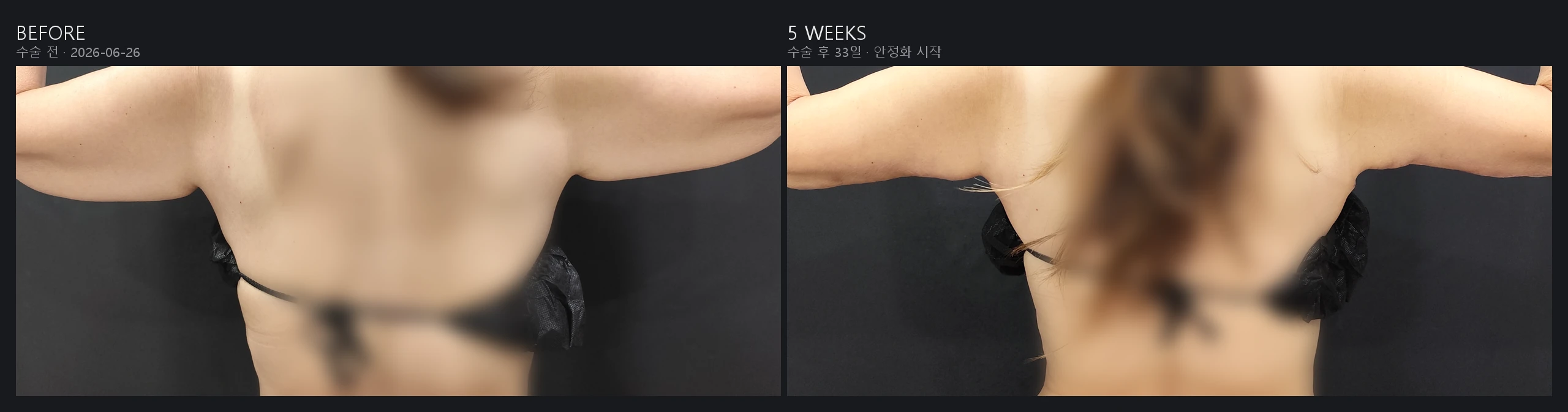
Arm Lift (Brachioplasty) – 5 Weeks After Surgery
Redundant upper-arm skin corrected by excision, photographed before surgery, at 14 days and at 33 days.
- Concern
- Redundant upper-arm skin, worse on abduction
- Procedure
- Brachioplasty (arm lift) with fusiform skin excision
- Incision
- Along the inner upper arm, from the axilla toward the elbow
- Photographs
- Before surgery, 14 days and 33 days after
Why excision, and not liposuction
This patient’s problem was loose skin, not excess fat. With the arms raised, the lower border of each upper arm fell away in a distinct curve.
Liposuction cannot fix that. Where skin has already lost its elasticity, taking fat out from underneath leaves the skin behind and often makes the looseness more obvious. Tightening the arm means removing skin, and removing skin means a permanent scar.
The scar is the trade-off of this operation. It runs the length of the inner upper arm, and it is permanent. A patient who is not willing to accept that scar is not a candidate for brachioplasty.
Evita Clinic
The surgical plan
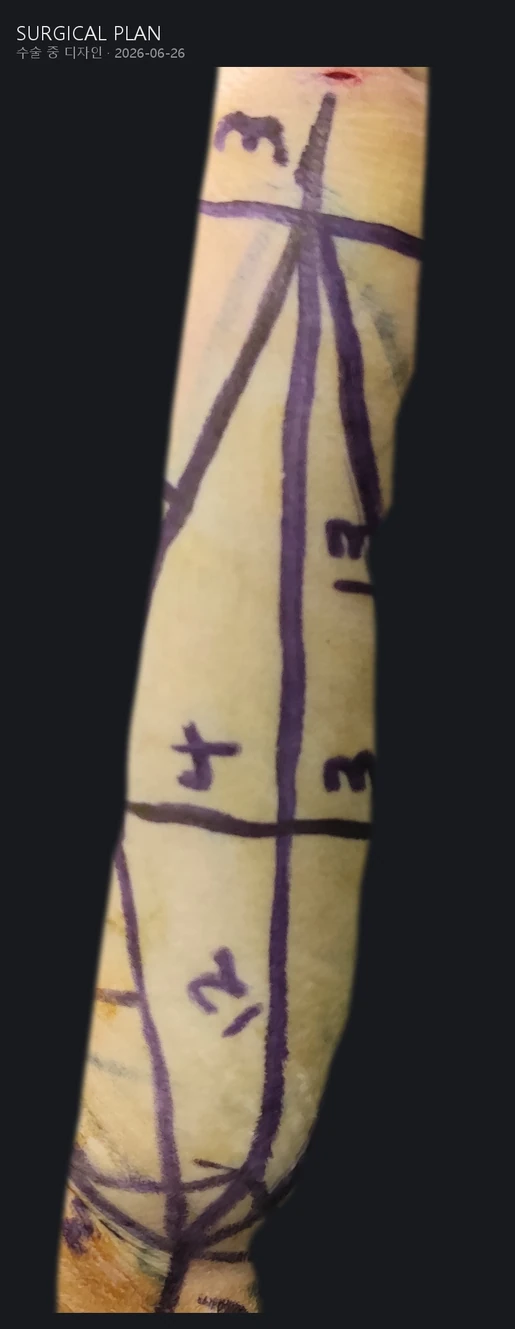
The marking shows the fusiform strip of skin to be excised, running from the armpit along the inner upper arm. Its width is judged with the arm in different positions so that the closure is neither loose nor under tension.
The short cross lines with paired numbers are alignment marks. After the strip is removed, the upper and lower wound edges are not the same length. Sewing matching numbered points to each other distributes that difference evenly along the arm, instead of letting it bunch up at one end.
What happens week by week
Up to 2 weeks — swelling is still present
The middle photograph was taken at 14 days. Swelling at this stage is expected and the arm looks fuller than it eventually will. Suture lines are visible in the armpit, with some residual redness and leftover surgical marking on the skin.
2 to 4 weeks — swelling subsides
Through this period the swelling comes down in earnest, and the contour created at surgery starts to show.
From about 4 weeks — the shape settles
By roughly four weeks the shape is reasonably stable. This is the point where care shifts from managing swelling to managing the scar, which is still red and firm in its early maturation phase.
Through 4 to 5 months — skin retraction continues
At five weeks some swelling and localised looseness remain, and that is a normal part of the course. Skin retraction continues to tighten the contour through roughly four to five months. The scar goes on fading for 6 to 12 months beyond that.
These are five-week photographs, not a final result. Neither the contour nor the scar has finished changing at this point. Judging brachioplasty from an early photograph will misrepresent it in both directions — the swelling makes the arm look fuller than it will be, and the scar looks angrier than it will be.
- Loose upper-arm skin is corrected by excision, not by liposuction.
- The scar runs the length of the inner upper arm and is permanent.
- Swelling persists for about two weeks, then subsides; the shape settles from around four weeks.
- Skin retraction keeps improving the contour to four or five months; the scar fades for 6 to 12 months.
About these images
The three sessions were photographed at slightly different camera distances. To make them comparable, the post-operative frames have been scaled so that shoulder width matches the pre-operative frame — a dimension this operation does not change. Nothing has been stretched, reshaped or retouched, and the same crop is applied to every frame.
The central chest is deliberately blurred so that attention stays on the arms. The arms themselves are untouched. Identifying features have been cropped out of frame rather than painted over.
Results vary depending on individual anatomy, healing response, lifestyle factors and postoperative care. These images are provided for informational purposes only and do not guarantee specific results.