Tummy Tuck After Major Weight Loss – 3 Weeks After Surgery
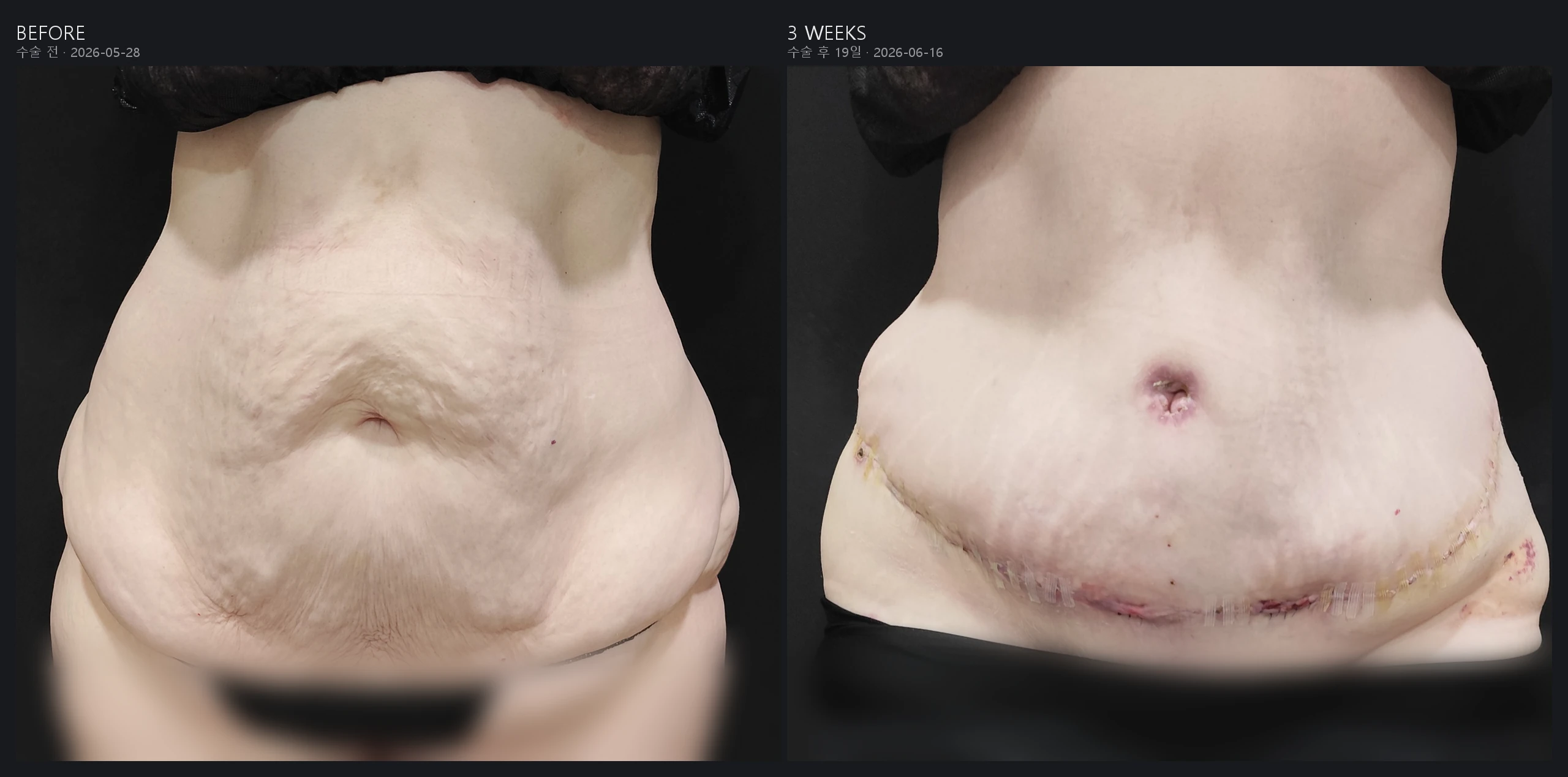
Redundant lower abdominal skin removed by excision, photographed before surgery and at 19 days.
- Concern
- Redundant lower abdominal skin after major weight loss
- Procedure
- Abdominoplasty with umbilical transposition
- Incision
- Low transverse, hip to hip, placed below the underwear line
- Photographs
- Before surgery and 19 days after
The problem was skin, not fat
After major weight loss this patient was left with an apron of redundant lower abdominal skin, deeply stretch-marked, hanging past the pubis. The tissue that remained was loose skin, not fat.
Liposuction does not solve this. Where the skin has already lost its elasticity, removing the fat underneath leaves the envelope behind and often makes the looseness more obvious. Flattening the abdomen means excising skin, and excising skin means a permanent scar.
The scar is the trade-off of this operation. It runs from hip to hip and it is permanent. It can be placed low enough to sit under underwear, but it cannot be avoided.
Evita Clinic
What was done
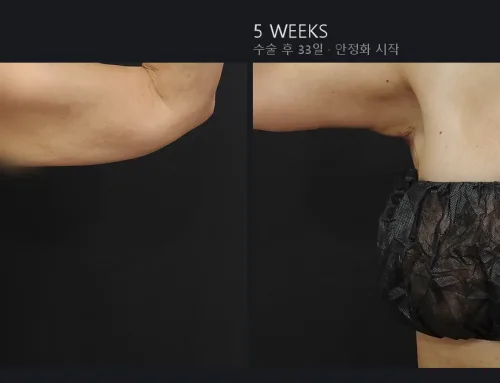
Abdominoplasty with excision of the redundant lower abdominal skin and transposition of the umbilicus to its new position. The incision was placed as low as possible so that it sits below the underwear line. Brachioplasty was performed at the same operation; those photographs are not published here.
This is a different problem from a lipoabdominoplasty, where circumferential fat is treated alongside the skin. Here the fat was not the issue.
What the photographs show at 19 days
The overhanging apron is gone and the abdominal contour is flat. The low hip-to-hip scar is visible, and the umbilicus is healing in its new position, still red and crusted.
Yellow crusting can be seen at both lateral ends of the incision. Those are the points of greatest tension across the closure, this is a common finding at three weeks, and it was under review at the time of the photograph.
Three weeks is not the finished result. The scar will stay red and firm for several months before it flattens and fades, and maturation continues beyond a year. Residual swelling means the abdomen still looks thicker than it eventually will. An early photograph understates the result and overstates the scar at the same time.
- Loose abdominal skin after weight loss is corrected by excision, not by liposuction.
- The scar runs hip to hip and is permanent; it is placed low so underwear covers it.
- The umbilicus is repositioned as part of the operation.
- Swelling and scar redness continue to settle for months after these photographs.
About these images
Both frames are cropped identically and shown at the same scale. Scale was verified against the thigh silhouette — tissue this operation did not touch — and the two sessions matched to within 1.5%. Nothing has been stretched, reshaped or retouched.
The crop excludes the face and other identifying features rather than painting over them. The underwear band at the foot of each frame is deliberately blurred; the abdomen and the scar are untouched.
Only the front view is published. The oblique and lateral files from this visit had been cropped before archiving, which left no way to verify their scale, so they were excluded rather than shown unverified.
Results vary depending on individual anatomy, healing response, lifestyle factors and postoperative care. These images are provided for informational purposes only and do not guarantee specific results.