
Thigh Lift Surgery in Seoul, Korea
An individualized thigh lift for loose skin after weight loss or reduced elasticity, with the incision selected according to where the laxity extends.
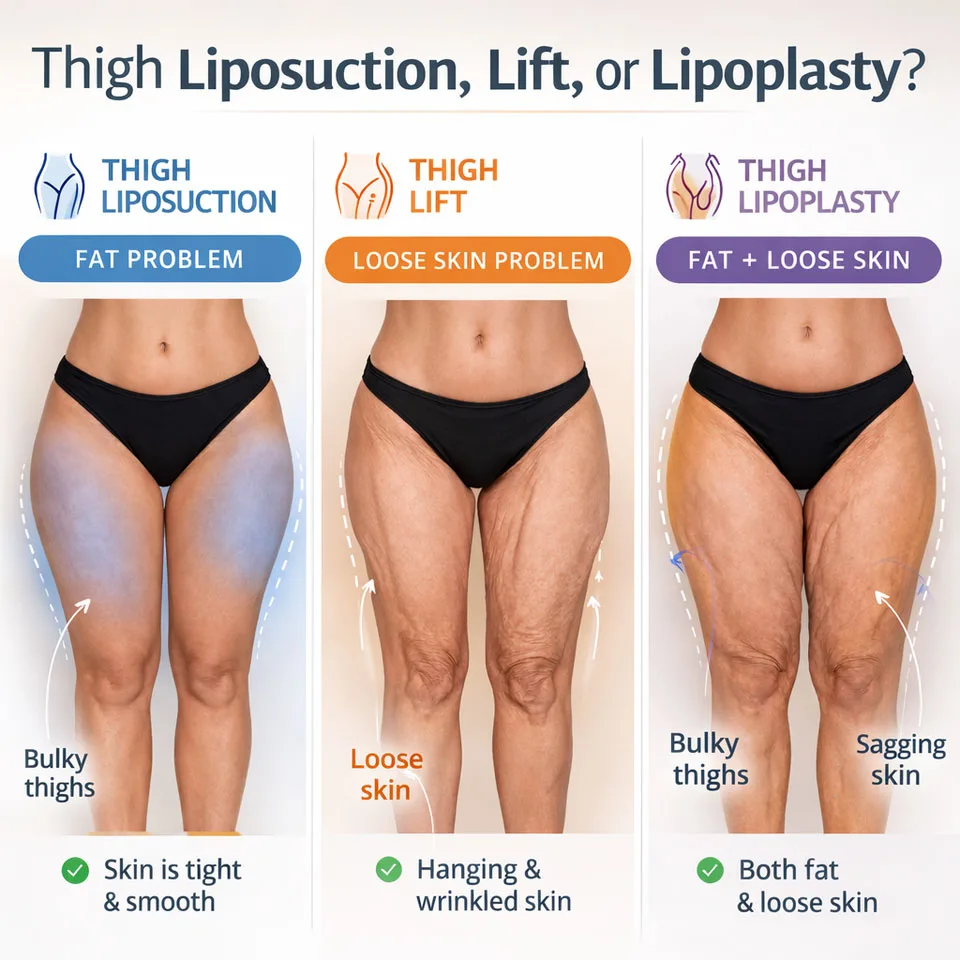
Do you need thigh liposuction, a thigh lift, or both?
The right treatment depends on whether the main concern is subcutaneous fat, loose skin, or both. Photos can guide an initial recommendation, but skin mobility, scar placement and the safe excision range must be confirmed in person.
✓ Liposuction may be enough
You have excess thigh or hip fat with reasonably elastic skin and little hanging tissue. Learn about thigh and hip liposuction.
✓ A thigh lift may be appropriate
You have folded, hanging or mobile skin after major weight loss, aging or loss of elasticity. Skin removal improves laxity but creates a permanent scar.
✓ Thigh lipoplasty may help
You have both circumferential excess fat and significant loose skin. Liposuction reshapes the thigh and hip, while a standard thigh lift removes redundant skin.
Thigh lift cost in Korea
Evita Clinic classifies thigh lift surgery by the location and length of skin removal. A shorter scar is appropriate only when the loose skin is limited to the area it can tighten.
Mini Thigh Lift
A crescent-shaped segment is removed along the groin crease. This is intended for limited upper inner-thigh laxity and cannot tighten skin extending toward the knee.
Korea stay: minimum 10 days; recommended 14 days
Standard Thigh Lift
A vertical inner-thigh excision, sometimes combined with a groin component, treats more extensive laxity through the medial thigh.
Korea stay: minimum 14 days; recommended 21 days
Extended Thigh Lift
The excision extends beyond the standard inner-thigh range toward the outer thigh when laxity involves a broader circumferential area.
Korea stay: minimum 21 days; recommended 28 days
Fixed fees include 10% VAT, consultation, anesthesia, surgery and routine postoperative clinic care. Postoperative medicines and compression garments are not included.
The scar must reach the loose skin
The operation is selected by where the skin sags, not only by a preference for a hidden scar. Pull from the groin diminishes rapidly farther down the thigh, so a mini lift cannot reliably correct mid-thigh or knee-level laxity.
| Procedure | Area corrected | Typical scar range | Main limitation or trade-off | Korea stay |
|---|---|---|---|---|
| Mini | Upper inner thigh | Crescent within or near the groin crease | Limited downward reach; scar may migrate under tension | 10 days minimum 14 days recommended |
| Standard | Upper to lower medial thigh | Vertical inner-thigh scar, with groin extension when needed | Long scar may be visible in shorter clothing | 14 days minimum 21 days recommended |
| Extended | Medial thigh plus outer-thigh extension | Longest incision across a broader thigh region | Largest wound and longest recovery burden | 21 days minimum 28 days recommended |
When is thigh lipoplasty considered?
Liposuction is not automatically added to every thigh lift. It is considered when excess fat contributes to the circumference or when the thigh, hip and adjacent contours need to be balanced.
- Loose skin with little fat: skin excision alone may be sufficient.
- Fat with elastic skin: 360° thigh and hip liposuction may be more appropriate.
- Fat plus substantial laxity: Thigh Lipoplasty combines 360° liposuction with a Standard Thigh Lift.
- Thin tissues after major weight loss: aggressive fat removal can worsen irregularity and compromise wound circulation.

Thigh Lipoplasty
360° Thigh & Hip Liposuction + Standard Thigh Lift
Korea stay: minimum 14 days; recommended 21 days
For liposuction alone: Thigh & Hip Liposuction is ₩3,850,000 KRW, with a minimum stay of 5 days and a recommended stay of 7 days.
How thigh lift surgery is performed
The final excision is marked while standing and checked with the thighs positioned for surgery. Evita Clinic performs the operation under monitored twilight sedation with tumescent local anesthesia rather than general anesthesia.
Examination and design
Dr. Francis Jeon evaluates fat thickness, skin mobility, asymmetry, groin position and how far the laxity extends down or around the thigh.
Liposuction if planned
Fat is reduced conservatively while preserving tissue needed for circulation, smooth contour and safe wound healing.
Skin excision and closure
The planned skin is removed and the wound is closed in layers, with attention to tension, scar placement and protection of superficial lymphatic structures.
Monitored recovery
ECG, oxygen saturation and blood pressure are monitored. Patients leave the clinic the same day after meeting recovery criteria.
What is recovery like after a thigh lift?
Recovery depends on incision length, whether liposuction is combined and individual wound healing. Swelling, bruising, tightness, temporary numbness and cautious walking are expected early.
What thigh lift surgery can improve
- Reduce hanging or folded inner-thigh skin
- Improve contour after major weight loss
- Reduce skin-on-skin rubbing or hygiene difficulty in selected patients
- Balance thigh volume when liposuction is also appropriate
- Make fitted clothing more comfortable for some patients
The operation improves contour but cannot create perfectly identical thighs, remove every crease or stop future aging and weight-related change.
The main trade-off is the scar
Every thigh lift leaves a permanent scar. A groin scar may be covered by underwear but can migrate downward or widen under tension. Standard and extended scars are longer and may show in shorter clothing.
- Scar width, color and elevation vary by individual healing.
- Groin wounds face moisture, movement and friction, which can delay healing.
- Scar care begins only after the wound has closed sufficiently.
- Scar revision is considered after adequate maturation, not during early healing.
Important considerations before a thigh lift
Longer excisions provide more correction but create a larger wound and greater recovery burden. Risk depends on health, smoking, BMI, tissue quality, mobility and the extent of combined surgery.
Wound and scar risks
- Delayed healing or wound separation
- Wide, raised, asymmetric or migrated scars
- Infection, bleeding, hematoma or seroma
- Skin-edge circulation problems or tissue loss
Lymphatic and contour risks
- Prolonged leg or knee swelling
- Lymphatic fluid collection or lymphocele
- Asymmetry, residual laxity or irregularity
- Numbness, firmness, tightness or chronic discomfort
General surgical risks
- Anesthesia-related complications
- Deep-vein thrombosis or pulmonary embolism
- Need for aspiration, prolonged wound care or revision
- Unsatisfactory scar or contour outcome
Thigh lift surgery questions
What is thigh lift surgery?
Thigh lift surgery, or thighplasty, removes loose skin from the inner and sometimes outer thighs. Liposuction may be added when excess fat is also present, but skin excision is what treats significant laxity.
What is the difference between thigh liposuction and a thigh lift?
Liposuction removes subcutaneous fat through small access incisions but cannot remove hanging skin. A thigh lift removes skin through a longer incision. When both fat and laxity are present, the procedures may be combined.
Can I choose a mini thigh lift to avoid a vertical scar?
Only when laxity is limited to the upper inner thigh. A groin-only incision has little tightening effect farther down the thigh. Choosing it for wider laxity means accepting residual loose skin and may place excessive tension on the groin scar.
Where are thigh lift scars located?
A mini lift places a crescent-shaped scar near the groin crease. A standard lift uses a longer medial-thigh scar, sometimes with a groin component. An extended lift continues toward the outer thigh according to the laxity pattern.
What is Thigh Lipoplasty?
At Evita Clinic, Thigh Lipoplasty is the fixed combination of 360° Thigh & Hip Liposuction and a Standard Thigh Lift. It is intended for selected patients who have both circumferential fat and significant loose skin.
What anesthesia is used?
Evita Clinic uses tumescent local anesthesia combined with monitored twilight sedation rather than general anesthesia. ECG, oxygen saturation and blood pressure are monitored throughout surgery and recovery.
Do I need to stay in the hospital?
No routine overnight admission is required. Patients are monitored after surgery and discharged the same day after meeting safety criteria. A responsible adult should accompany the patient after sedation.
How long should I stay in Korea?
The current minimum and recommended stays are 10 and 14 days for Mini, 14 and 21 days for Standard, and 21 and 28 days for Extended Thigh Lift. For Thigh Lipoplasty, they are 14 and 21 days.
When are drains removed?
Closed suction drains are commonly removed about 2–3 days after surgery when the amount and character of drainage are appropriate. The schedule can change according to the operation and early healing.
When can I exercise after a thigh lift?
Gentle walking begins early, but wide leg movements, deep squats and strenuous lower-body exercise are restricted. Workouts should wait at least one month and resume only after Dr. Jeon confirms that the wound is secure.
How long do I wear a compression garment?
Evita Clinic generally recommends compression for at least 8 weeks, although the schedule may be adjusted for swelling, wound healing and garment fit.
Can I see another patient’s before-and-after photos?
Evita Clinic does not privately share another patient’s photographs on request. Only cases published with specific patient consent may be viewed on the clinic’s public website.
Thigh contouring by Dr. Francis Jeon
Dr. Francis Jeon is a board-certified thoracic and cardiovascular surgeon and the founder of Evita Clinic in Seoul. Since establishing the clinic in 2009, he has focused on gynecomastia, breast surgery and body contouring for Korean and international patients.
His thigh lift planning balances the amount and location of loose skin with scar length, wound tension, circulation, lymphatic preservation and safe operating time. The goal is a proportionate improvement with a scar that matches the actual area requiring correction.
Medically reviewed by Dr. Francis Jeon · Last reviewed: July 21, 2026
Find out which thigh lift range fits your anatomy
Send clear standing front, back and both side photos from the waist to below the knees. Please include your age, sex, height, weight, weight-loss history, medical conditions, medications, allergies, smoking status and whether your weight is stable.
Our English coordinator replies during Korea business hours (Mon–Fri, 10:00–18:00 KST).