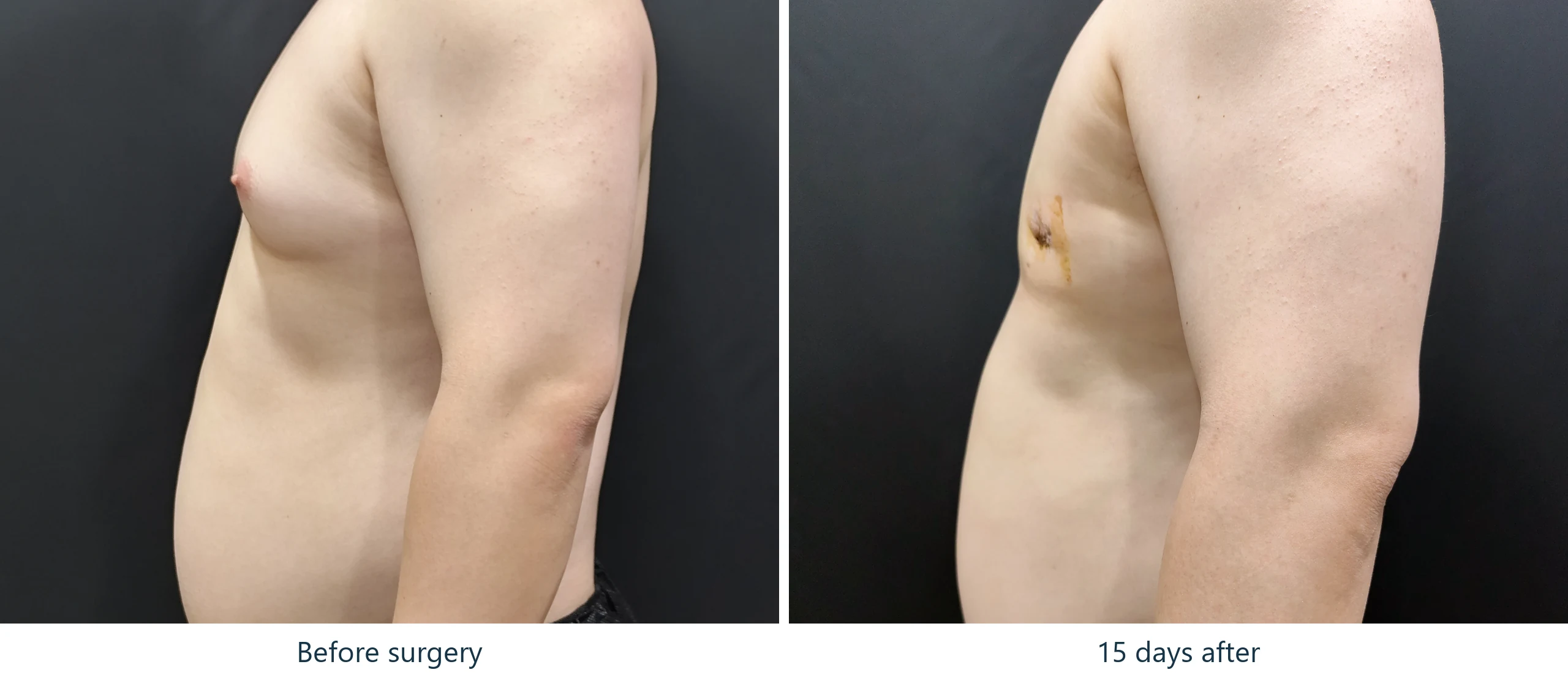
Gynecomastia Surgery (Liposuction with Glandular Excision) – 6 Weeks After Surgery
Grade 2 gynecomastia, photographed before surgery and at 8, 15 and 40 days — what changes, and when.
- Concern
- Grade 2 gynecomastia — firm glandular tissue with nipple protrusion
- Procedure
- Liposuction with glandular excision through a periareolar incision
- Tissue excised
- 59 g right, 84 g left, in addition to aspirated fat
- Photographs
- Before surgery, 8, 15 and 40 days after
The shape is corrected at surgery — not gradually over the following weeks. The chest is already flat in the 8-day photograph. What changes between 8 days and 6 weeks is the bruising, the swelling and the wound. Recovery is about the skin settling down, not about the contour slowly arriving.
This distinction matters, because the first two weeks are when patients worry most. At 8 days the chest is covered in bruising and the areolar wounds are still closed with sutures. It looks alarming. The underlying shape at that moment is already the shape that will be there at six weeks.
What the photographs show
Before surgery
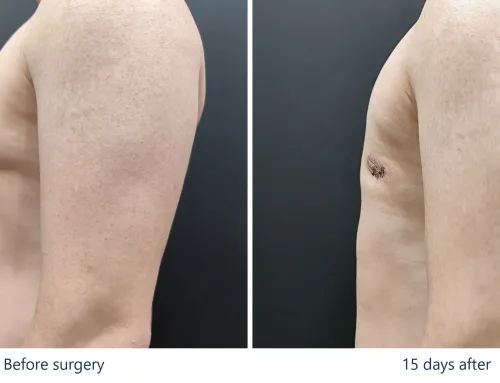
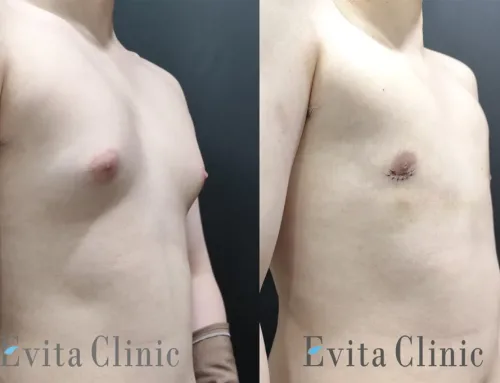
Firm tissue behind each nipple lifted the chest into a distinct mound, with the nipple itself pushed forward. The side view shows this most clearly: the breast projects in a cone with the nipple at its apex. This is Grade 2 gynecomastia — moderate enlargement without significant skin excess.
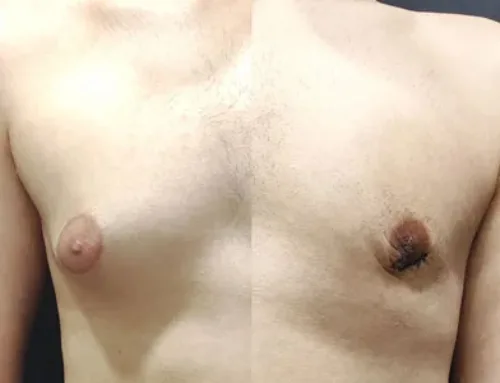
8 days — the bruising is at its worst
The contour is flat. Everything else about this photograph looks worse than it will at any later point: yellow-green bruising covers the chest and tracks down toward the upper abdomen, and the periareolar incisions are closed with visible sutures.
This is a normal course, not a complication. Bruising after gynecomastia surgery typically peaks in the first week to ten days and then drains downward under gravity, which is why it appears lower on the chest as it fades.
15 days — bruising largely gone
Two weeks on, the bruising has mostly cleared. The wounds at the areolar border are still crusted and are not yet scars — they are healing skin. The side view at this stage shows the projection has gone: the chest profile is flat where it previously curved forward.
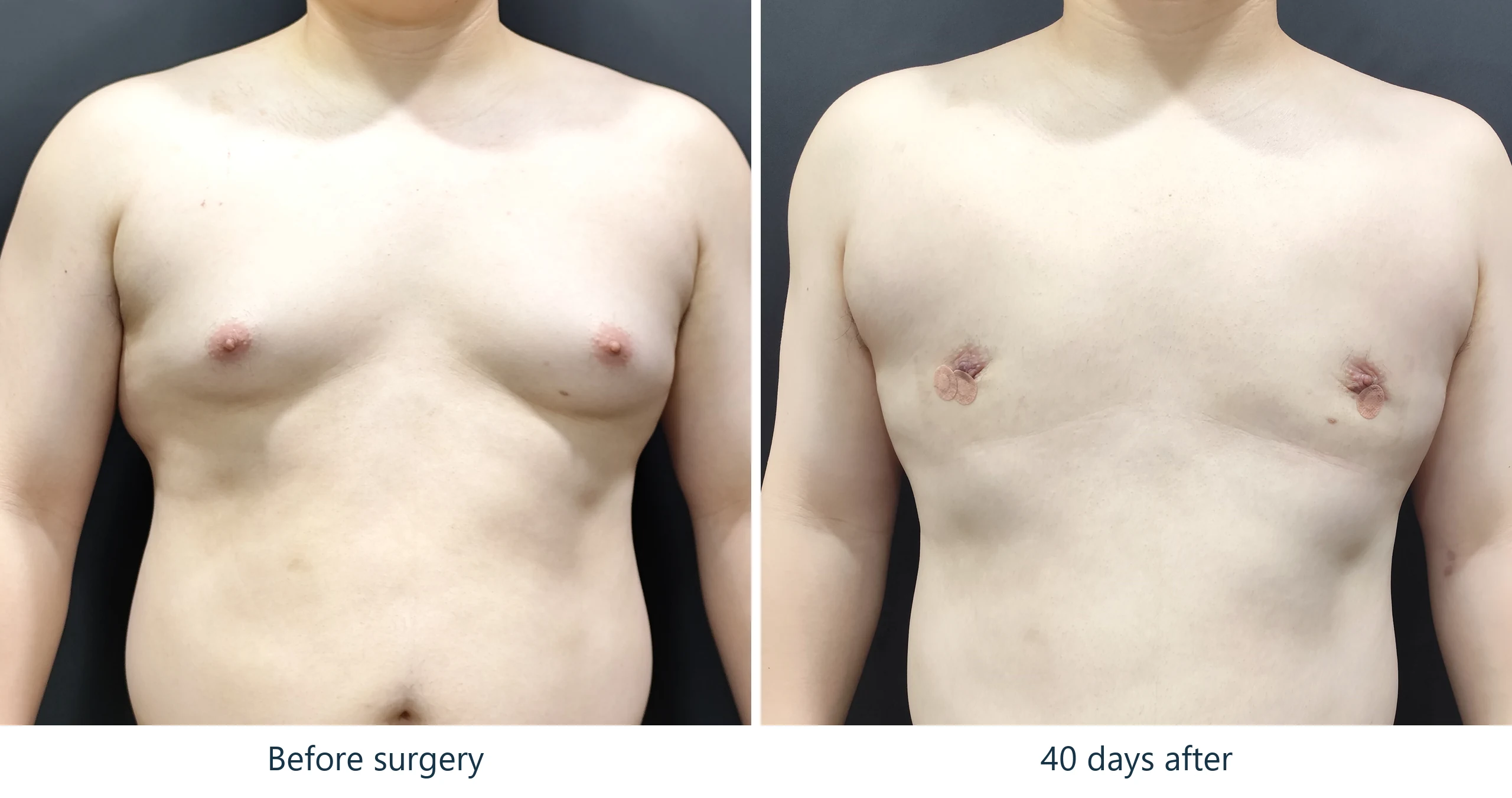
40 days — settled
Swelling has resolved and the incision line has begun to blend into the lower border of the areola. Small dressings are still on the nipples in this photograph.
Why liposuction alone would not have worked
Gynecomastia is not simply fat on the chest. In this case the excised specimens weighed 59 g on the right and 84 g on the left, and were dense fibrous glandular tissue mixed with fat.
Liposuction removes fat. It does not remove glandular tissue, which is far too firm to pass through a cannula. Treating a chest like this one with liposuction alone would take out the surrounding fat and leave the firm disc behind — and with the softer tissue around it gone, that disc frequently becomes more obvious, not less.
Liposuction thins the chest. Excision is what removes the gland. Grade 2 gynecomastia needs both, which is why the incision at the areolar border is part of the operation rather than an optional extra.
Evita Clinic
The scar
The incision runs along the lower border of the areola, where the pigmented skin meets ordinary chest skin. That border hides a scar well, because the colour change along the line disguises it.
It is still a permanent scar. In the 8-day photograph the sutures are in place and the line is obvious; by 40 days it has begun to settle into the areolar edge. Scars of this kind continue to fade over roughly 6 to 12 months.
Show the incision at 8 days (clinical close-up)

What this operation did not do
This was chest surgery. The abdomen is unchanged across all four photographs, and it was never the target of the operation. Gynecomastia surgery corrects the chest; it is not a weight-loss procedure and it does not contour the trunk.
Patients whose main concern is generalised body fat rather than glandular tissue are usually better served by a different conversation, and often by no operation at all.
These are 40-day photographs, not a final result. The scar is early in its maturation and will continue to fade for 6 to 12 months. The faint horizontal line crossing the chest in the 40-day image is a pressure mark from the compression garment, not a scar or an incision — it settles within hours of the garment coming off.
- The chest contour is corrected at surgery and is already flat at 8 days.
- What improves over the following weeks is bruising, swelling and wound healing — not the shape.
- Bruising peaks in the first week to ten days; this is expected, not a complication.
- Grade 2 gynecomastia needs excision as well as liposuction, because glandular tissue cannot be suctioned.
- The scar sits at the lower areolar border and fades over 6 to 12 months.
About these images
The four sessions were photographed at different camera distances — the 8-day session was shot roughly 13% closer than the pre-operative one, and the 40-day session roughly 13% further away. Left uncorrected, that alone would make the chest appear to change size between panels.
Each post-operative frame has therefore been scaled so that the shoulders and collarbones match the pre-operative frame — a region this operation does not alter. The alignment was solved by computer rather than by eye, and the same crop is applied to every panel. Brightness and colour were matched between sessions using the backdrop and the shoulder skin as references; the bruising was deliberately excluded from that calculation so that it was not corrected away.
Nothing has been stretched, slimmed, reshaped or retouched. Identifying features have been cropped out of frame rather than painted over.
Results vary depending on individual anatomy, healing response, lifestyle factors and postoperative care. These images are provided for informational purposes only and do not guarantee specific results.