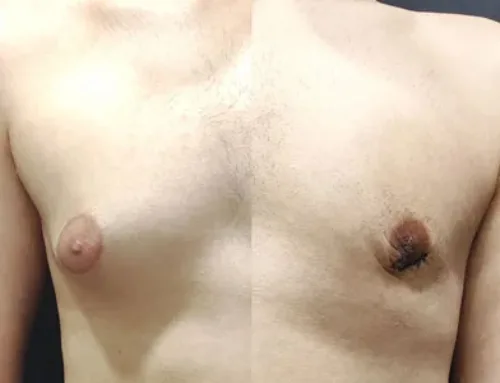
Grade 4 Gynecomastia – Skin Excision Was Needed, and the Patient Declined It
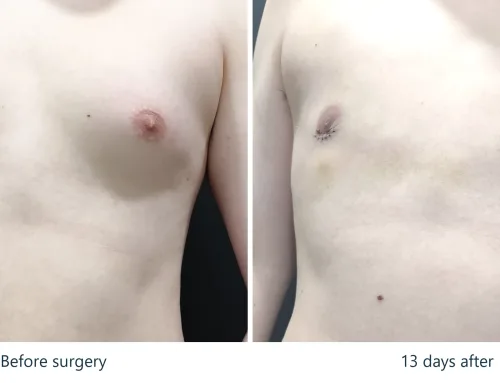
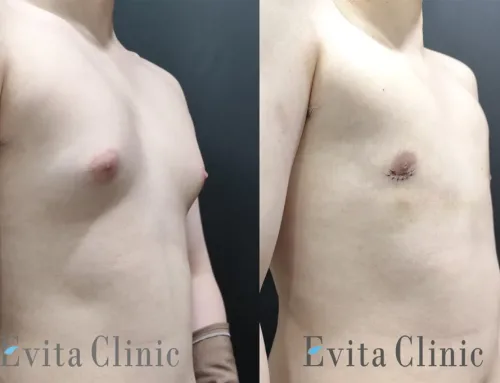
261 grams of gland removed through the areolar border alone. The sagging you will see was predicted, explained, and accepted before surgery.
Please read this before looking at the photographs.
This patient needed skin excision. At Grade 4 the skin has been stretched for years, and removing the gland from underneath does not shrink it. The correct operation for his chest included cutting the excess skin away.
He was told that, and he declined it. He was told specifically that without skin excision his chest would sag once the swelling settled. Knowing that, he asked to proceed through the areolar border only — the minimal incision — so that he could first try to fill the loose skin with muscle, and decide about a second, skin-only operation later.
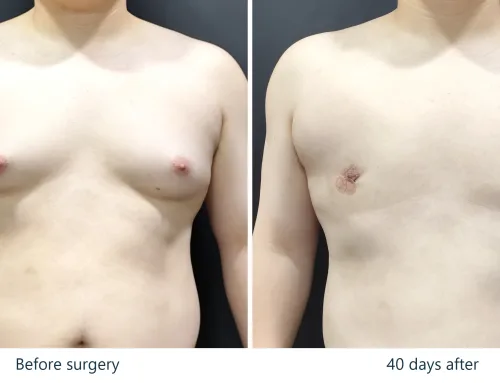
What follows is therefore a deliberately partial correction. The looseness visible in these images is not an unexpected outcome or a shortcoming of the surgery. It is the consequence the patient chose, with that consequence explained to him in advance.
- Concern
- Grade 4 gynecomastia — large breast with the nipple pointing downward
- Indicated operation
- Gland excision with skin excision
- Operation performed
- Gland excision only, through the areolar border
- Why the difference
- Skin excision declined by the patient, with the sagging explained in advance
- Tissue excised
- 159 g right, 102 g left — 261 g in total
- Photographs
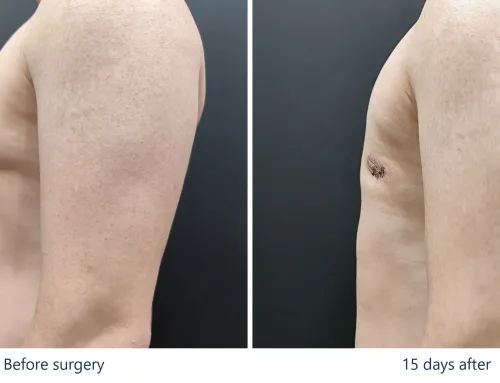
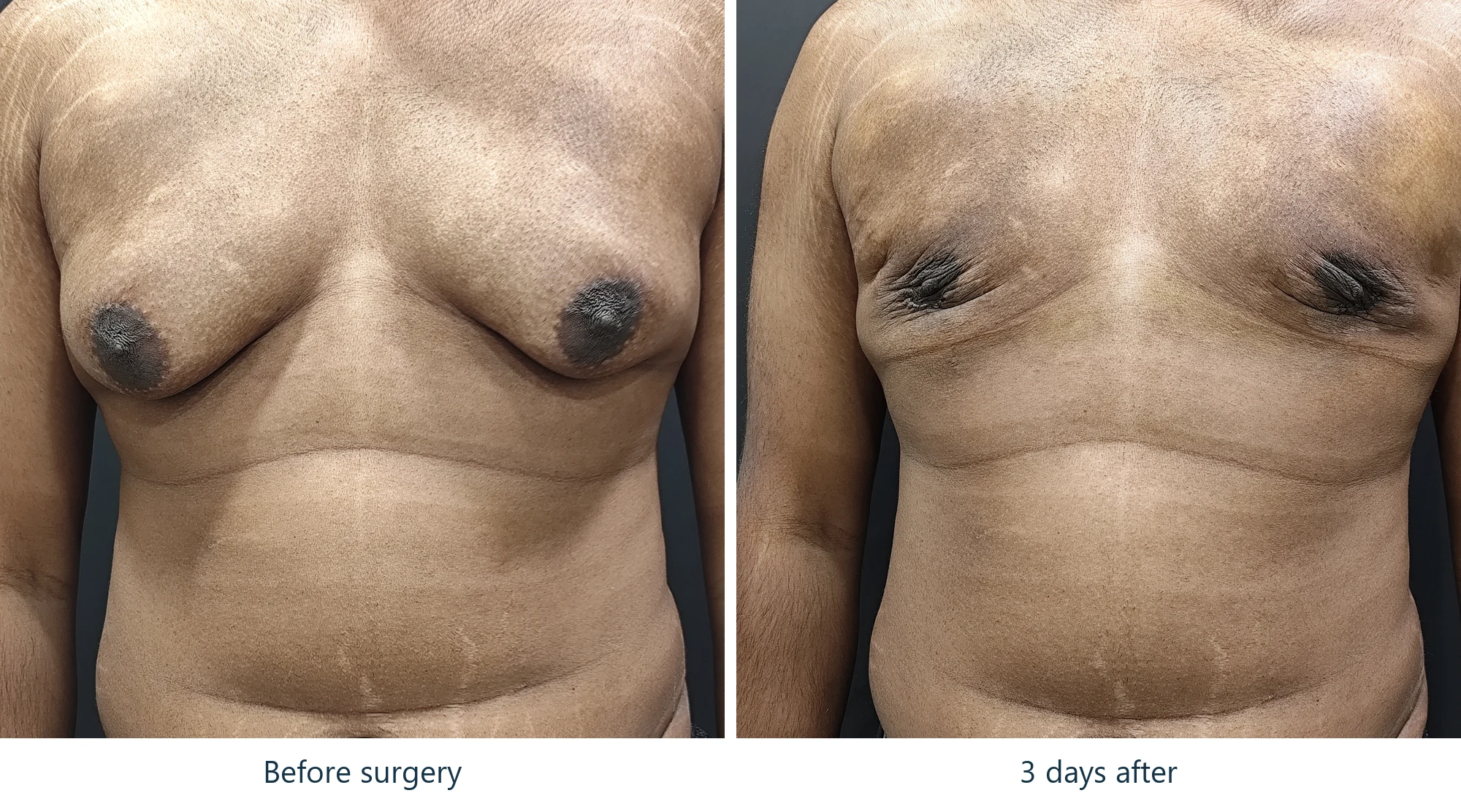
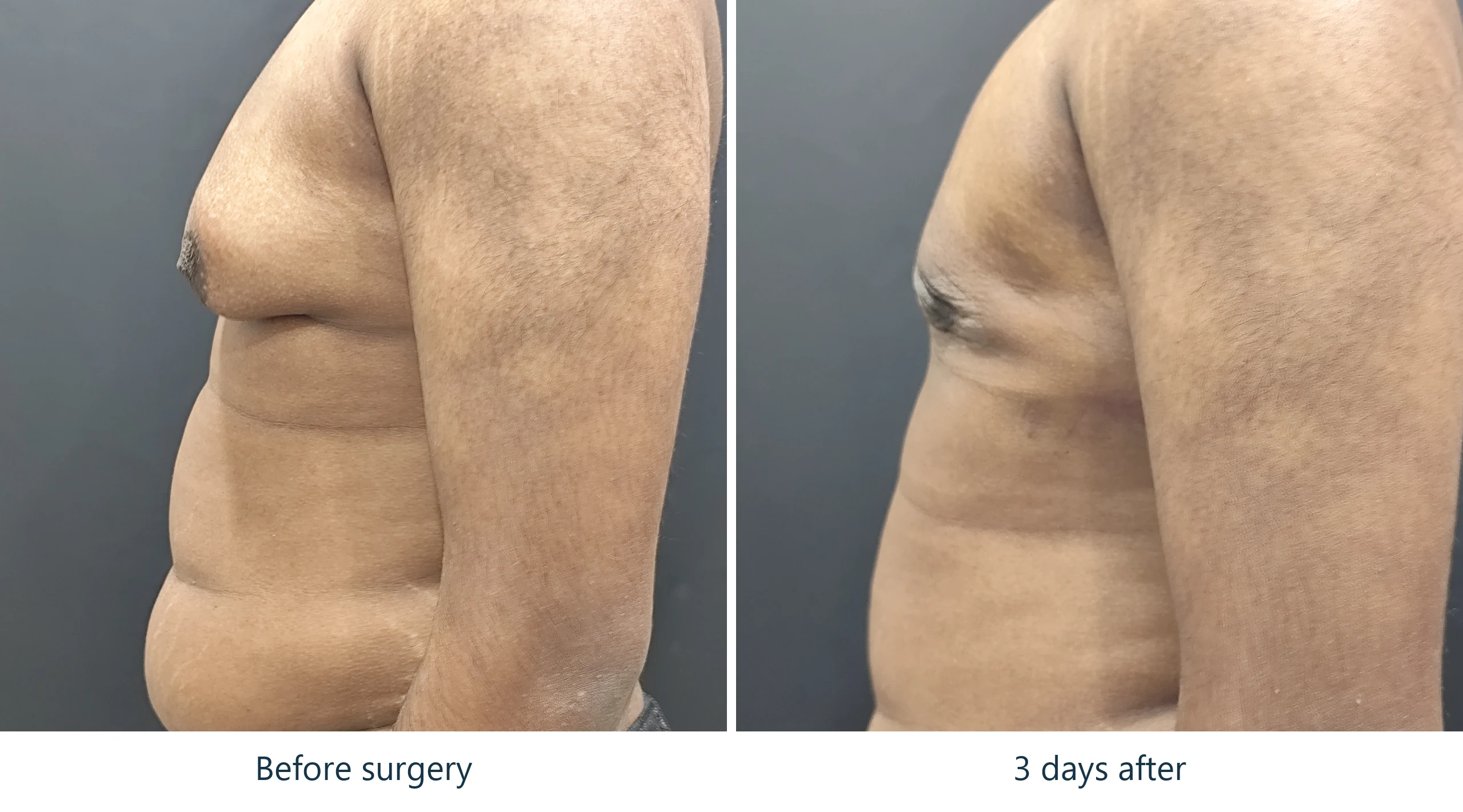
- Before surgery and 3 days after
At Grade 4 there are two problems, and this operation treated only one of them — on purpose. The gland was removed: 261 grams of it. The stretched skin that had been wrapped around it was left exactly where it was, because the patient weighed a permanent chest scar against visible looseness and chose the looseness.
What Grade 4 means
The grading scale runs from a small disc behind the areola up to a chest that reads as a female breast. This patient was at the top of it: substantial volume, and enough weight in the tissue that the nipple was carried downward rather than forward. That downward-pointing nipple is the marker of the highest grade.
At this grade the skin has been stretched for years. Taking out the tissue underneath does not shrink the envelope that was holding it. Some of it contracts on its own; how much is individual, and it takes many months to find out.
The two operations, and which one he chose
Gland excision with skin excision removes the tissue and the surplus skin in one sitting. It gives a tight chest immediately. It costs a scar that runs across the chest, not one hidden at the areolar border, and that scar is permanent.
Gland excision alone goes in through the areolar border. The scar is small and sits in the colour change at the edge of the areola. It removes the mass but leaves the skin, so at this grade the chest will be loose afterwards.
He was told both, and told plainly that in his case the second option would leave visible sagging. He chose it anyway, with a plan: build muscle first, see how much of the looseness that fills out, and come back for a skin-only operation if it does not.
This is not an incomplete operation, and it is not a compromise we recommended. It is the first stage of a two-stage plan that the patient chose with the trade-off spelled out in front of him — accept looseness now and keep his options open, or accept a chest scar today.
Evita Clinic
Why the photograph is taken this early
Most before-and-after photographs are taken at three months, once things have settled. A three-day photograph shows something a three-month photograph cannot: it separates what the operation did from what healing did.
At three days nothing has healed. The chest is swollen and the wounds are fresh. The flat profile in the second photograph is therefore entirely the result of removing tissue — no skin retraction and no resolution of swelling has contributed to it yet. That is the cleanest possible demonstration that the shape of gynecomastia is made of tissue.
It also means the swelling is currently holding the loose skin out. As it goes down over the coming weeks, the looseness described above will become more apparent, not less.
This is the earliest photograph we publish, and it cannot show the things that take time.
Swelling. Three days is near the peak. The chest will keep changing shape for months as it resolves.
Skin. Because skin excision was declined, loose skin is expected in this patient and will become visible as the swelling settles. How much retracts on its own, and whether he proceeds to the second operation, cannot be judged from an image taken at three days.
- Grade 4 gynecomastia carries enough weight that the nipple points downward.
- At this grade there are two problems: the gland, and the skin stretched around it.
- This patient needed skin excision and declined it, knowing his chest would sag.
- 261 g of gland was removed through the areolar border alone.
- The looseness in these photographs is a chosen trade-off, not an unexpected result.
- A three-day photograph shows the tissue change and nothing else.
About these images
Both sessions were photographed against the same backdrop, with the patient’s written consent. No identifying features are in frame.
The post-operative frames have been scaled by 1.155 to match the pre-operative ones. That figure deliberately does not come from the chest: at Grade 4 the chest is precisely what changed, and the nipples move as a direct result of the operation, so neither can serve as a reference. It comes from two independent places instead. The side-view pair from the same two sessions aligns cleanly on the shoulder and neck — two separate measurement windows agreed to within 1% — and photographs taken in one sitting share a camera position. Separately, three measurement windows on the abdomen, which this operation does not touch, bracketed the same figure. Alignment is anchored on the navel.
Brightness was matched on skin alone, and barely at all: the shoulder skin already agreed to within 1.5% between the two sessions. The two backdrops render slightly differently and have been left as shot rather than forced to match, which would have tinted an entire panel to correct something the reader is not looking at.
Nothing has been stretched, slimmed, reshaped or retouched. Results vary depending on individual anatomy, healing response, lifestyle factors and postoperative care. These images are provided for informational purposes only and do not guarantee specific results.