Can you have stubborn lower abdominal fat even with a normal BMI?
The answer is yes.
In fact, some of the most common patients we see are people with healthy BMI values who struggle with persistent lower abdominal fullness — despite regular exercise and an otherwise healthy lifestyle.
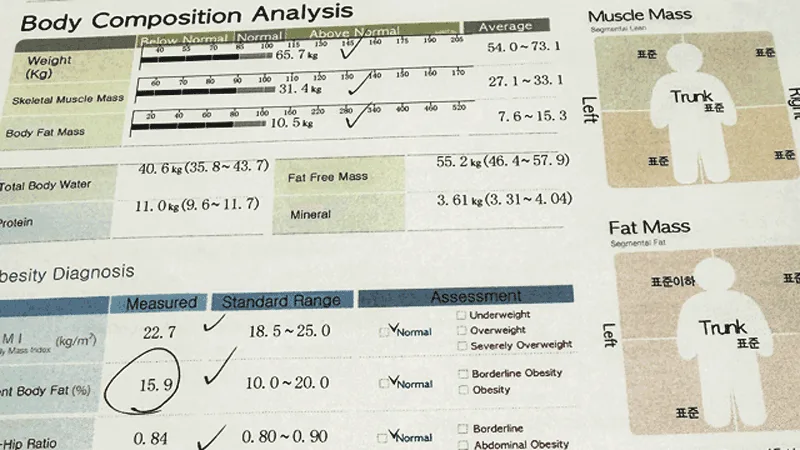
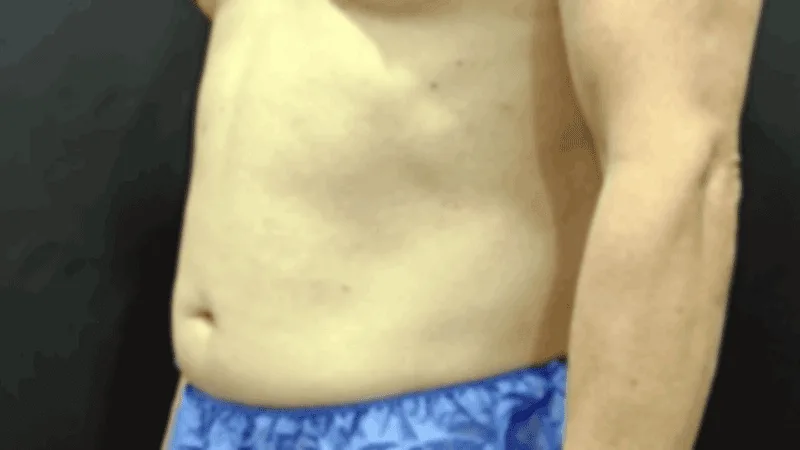
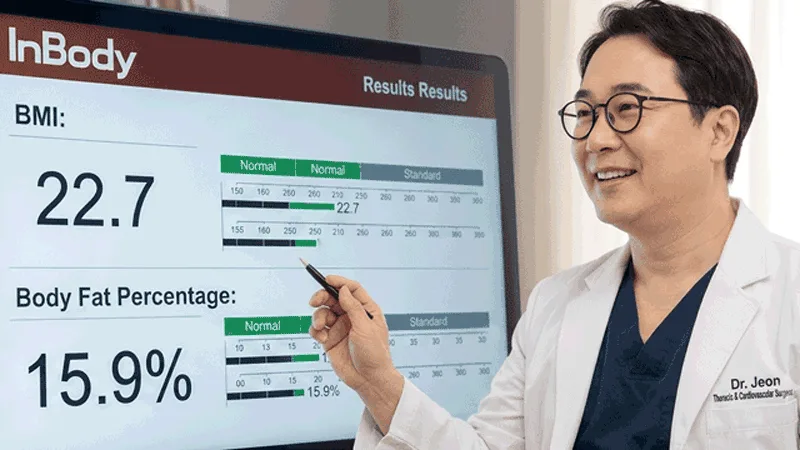
A recent case illustrates this well. A 54-year-old patient came to our clinic for a consultation regarding abdominal liposuction. His InBody body composition analysis was excellent: BMI 22.7, body fat percentage 15.9%, normal skeletal muscle mass, and low visceral fat. By nearly every objective measurement, his body composition was healthy. Yet his concern was familiar: “I exercise regularly, I maintain my weight, but my lower abdomen simply won’t go away.”
This pattern is common enough that it deserves a real explanation — one that goes beyond “exercise more.”
BMI Measures Weight — Not Fat Distribution
BMI is a useful tool for estimating whether someone is underweight, overweight, or obese. Body fat percentage adds more detail about total fat mass. However, neither measurement reveals where fat is stored in the body.
Two people with identical BMI and body fat percentage can look completely different — one with a flat abdomen, another with a noticeable lower abdominal bulge. In clinical practice, patients with perfectly normal body composition frequently report this exact concern: persistent lower abdominal fullness.
Why Does Lower Abdominal Fat Persist? Two Everyday Reasons
1. Aging and Skin Elasticity
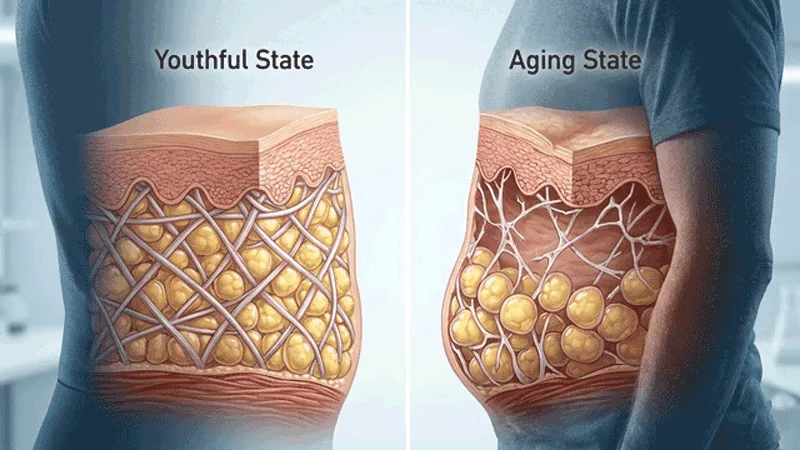
As we age, collagen and elastin gradually decline and connective tissue becomes less organized. Skin loses elasticity, and the lower abdominal tissues become looser than they were in earlier decades. The same amount of fat begins to occupy a different shape — settling lower and becoming more visible — even without any change in body weight.
2. Modern Sedentary Lifestyle
Humans evolved to walk, climb, and change posture constantly throughout the day. Today, many people sit for most of their waking hours — at a desk, in a car, in front of a screen. The lower abdomen remains flexed for prolonged periods while the abdominal muscles are used far less than in previous generations. Over time, this contributes to reduced tissue tone and weaker support of the lower abdominal wall.

The Evolutionary Reason: Why the Body Holds On to Lower Abdominal Fat
Human physiology evolved over millions of years in environments where food scarcity—not abundance—was the norm. Famine, harsh winters, failed hunts, and unpredictable food supplies were part of everyday life. In such an environment, the body’s ability to store excess energy efficiently was not a flaw—it was a powerful survival advantage.
One widely discussed explanation for this is the Thrifty Gene Hypothesis, which proposes that humans evolved highly efficient fat-storage mechanisms because food availability was historically unpredictable. Fat was never the enemy; it was emergency reserve energy, helping our ancestors survive periods of starvation.
Although the Thrifty Gene Hypothesis is not universally accepted as the sole explanation for obesity, it remains one of the most influential evolutionary models for understanding human fat storage.
Today, however, we live in an environment fundamentally different from the one in which our metabolism evolved. Food is abundant, high-calorie meals are available year-round, and prolonged famine has become rare in much of the developed world. Yet our biology has changed very little. Evolution operates over thousands to millions of years—not decades.
This evolutionary mismatch helps explain why the human body remains remarkably efficient at storing fat—even when excess energy is no longer essential for survival.
Why the Lower Abdomen Specifically? The Storage Environment Theory
I often explain this to patients using a framework I call the Storage Environment Theory — not a formal scientific theory, but a way of describing a pattern I consistently observe in clinical and surgical practice.
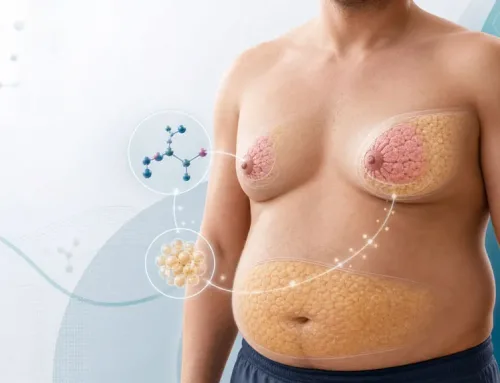
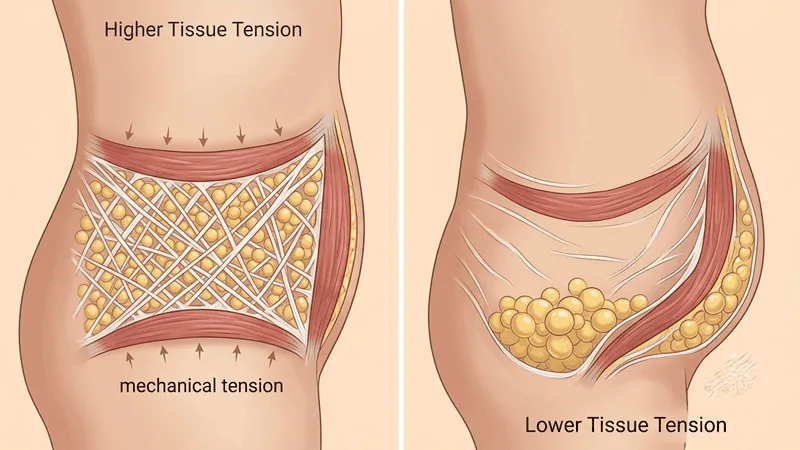
Fat cells do not actively migrate toward empty spaces, and they do not consciously seek out “safe” locations in the body — that would misrepresent the biology. However, over decades, body fat tends to persist in regions where the surrounding tissue becomes mechanically stable, experiences less movement, and gradually loses structural tension.
In other words: the body is not choosing the lower abdomen. The lower abdomen gradually becomes an ideal storage environment — as connective tissue loosens with age and the area sees less mechanical activity than it once did. This helps explain why it’s often the last area to slim down, even in otherwise lean individuals.
What I See in the Operating Room
Body composition scans and BMI calculations can only tell part of the story. During liposuction surgery, I have the opportunity to directly observe the tissue layers beneath the skin — something no scan can replicate.
One consistent finding, across nearly two decades and thousands of body contouring procedures: younger patients typically have tighter, more organized connective tissue, while older patients often show noticeably looser fibrous support in the lower abdomen — even when their BMI and body fat percentage are nearly identical.
This structural difference cannot be measured by BMI or body fat percentage alone, yet it plays a major role in how fat is distributed and how the abdomen appears from the outside. It is one of the clearest confirmations, in my experience, of what I describe above as the Storage Environment Theory — the looser and more mechanically stable the tissue becomes, the more readily fat is retained there.
Why Exercise Alone Often Isn’t Enough
A common question we hear: “If I keep doing abdominal exercises, will my lower belly fat disappear?”
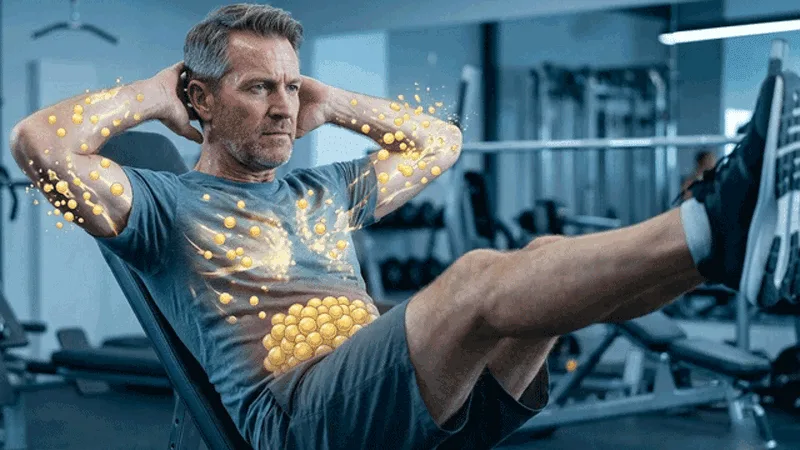
Unfortunately, spot reduction is not physiologically possible. Exercise supports overall health and body composition, but the body cannot selectively burn fat from one specific area. Fat loss occurs across the whole body, and the lower abdomen tends to be one of the last regions to respond due to genetics, aging, hormonal factors, and tissue structure. This is why even individuals with a body fat percentage around 15% may still notice fullness below the navel.
Liposuction Is a Contouring Procedure — Not a Weight-Loss Treatment
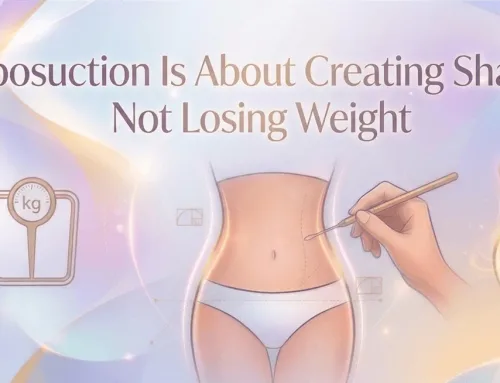
Liposuction should never be viewed as a method for losing weight. It is a body contouring procedure designed for cases where fat distribution remains disproportionate despite an otherwise healthy body composition.
That said, not every protruding lower abdomen is a liposuction candidate. The underlying cause may instead be:
- Skin laxity
- Muscle separation (diastasis recti)
- Visceral fat
- Localized subcutaneous fat
- Or a combination of the above
An accurate diagnosis should always precede any treatment recommendation.

Dr. Jeon’s Clinical Insight
One of the most important lessons I’ve learned after nearly two decades of performing body contouring surgery is this:
People rarely come to my clinic because they weigh too much. They come because their body shape no longer reflects the effort they’ve put into maintaining it.
BMI and body fat percentage are valuable clinical measurements, but they cannot fully explain body contour. Understanding why fat persists in a particular area is often more important than simply measuring how much fat is present.