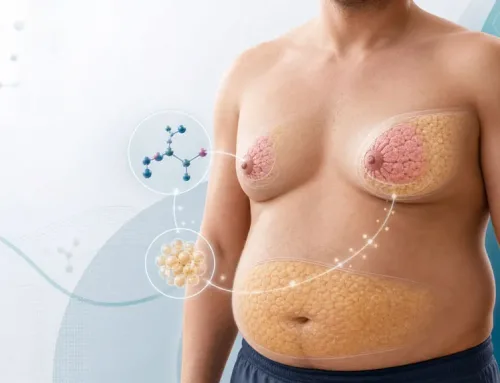
For many transgender men and transmasculine individuals, top surgery is one of the most significant steps in their transition journey. The goal is not simply breast removal, but creating a natural-looking masculine chest that matches the patient’s anatomy and gender identity.
When discussing FTM top surgery, most people are familiar with the Double Incision technique. However, not every patient requires large chest incisions.
Patients with a naturally small chest, typically B cup or smaller, or those who have experienced significant breast tissue atrophy after long-term testosterone hormone replacement therapy (HRT), may be candidates for minimal-scar top surgery.
In properly selected patients, complete gland removal and chest contouring can be achieved through very small incisions, resulting in less visible scarring, shorter recovery times, and excellent chest masculinization outcomes.
The two most common minimal-scar techniques are:
- Keyhole Top Surgery
Periareolar (Circumareolar) Top Surgery
Although both procedures aim to minimize scarring, they are not identical. Understanding their differences can help patients determine which option may be most appropriate for their anatomy and goals.
Who Is a Candidate for Minimal-Scar Top Surgery?
Minimal-scar techniques are generally best suited for patients who have:
- Small breast volume
Good skin elasticity
Minimal skin excess
Little to no breast sagging (ptosis)
Favorable nipple position
Many patients who have been on testosterone therapy for several years notice that their breast tissue becomes smaller and flatter over time. In some cases, this shrinkage can make a patient eligible for Keyhole or Periareolar surgery even if they were not originally considered ideal candidates.
Patients with larger chests, significant skin excess, or substantial breast sagging are usually better candidates for Double Incision Top Surgery.
What Is Keyhole Top Surgery?
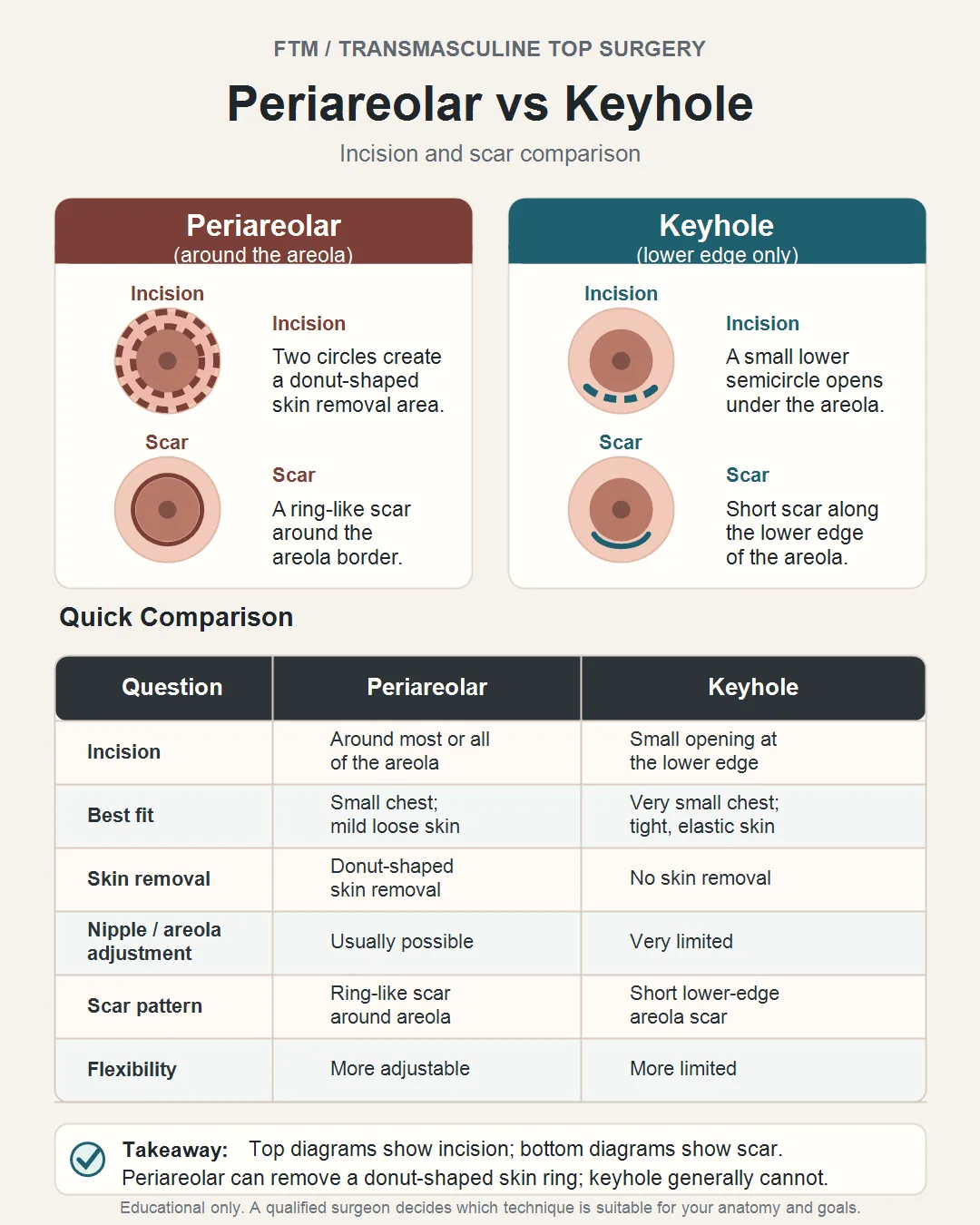
Keyhole Top Surgery uses a small semicircular incision placed along the lower border of the areola.
Through this opening, the surgeon removes glandular breast tissue and performs liposuction when necessary to improve chest contour.
Because the incision is extremely small, the blood supply and nerves to the nipple remain largely intact.
Advantages of Keyhole Surgery
Minimal visible scarring
- Minimal visible scarring
- Excellent preservation of nipple sensation
- No nipple grafting required
- Shorter surgery time
- Faster recovery
- Natural chest appearance
Limitations of Keyhole Surgery
- No skin removal
- Limited ability to resize the areola
- Limited ability to adjust nipple position
- Less flexibility for contour corrections
- Requires excellent skin elasticity
The success of Keyhole surgery depends heavily on the skin’s ability to contract naturally after breast tissue removal.
What Is Periareolar (Circumareolar) Top Surgery?
Periareolar surgery, sometimes called Circumareolar Top Surgery or the Donut Technique, involves making circular incisions around the areola.
A ring of skin can be removed if necessary, allowing the surgeon to tighten the chest skin while removing breast tissue.
This additional flexibility makes Periareolar surgery suitable for patients who have slightly more skin excess than ideal Keyhole candidates.
Advantages of Periareolar Surgery
- Limited skin removal is possible
- Areola size can be reduced
- Better management of mild skin laxity
- Greater contouring flexibility
- Minimal visible scarring
Limitations of Periareolar Surgery
- Circular scar around the areola
- Longer healing compared with Keyhole
- Limited nipple repositioning
- Not suitable for larger chests
- Less effective when significant skin removal is required
For many patients, Periareolar surgery serves as a middle ground between Keyhole and Double Incision techniques.
Complete Gland Removal Is Still Possible
A common misconception is that minimal-incision techniques remove less breast tissue than Double Incision surgery.
This is not true.
When performed by an experienced surgeon, both Keyhole and Periareolar procedures can achieve complete glandular tissue removal.
At Evita Clinic, minimal-scar chest masculinization combines:
- Complete gland removal
- Liposuction-assisted contouring
- Chest sculpting for a masculine appearance
The primary differences between techniques involve skin management, nipple adjustment, and scar placement—not the completeness of breast tissue removal.
Recovery After Keyhole or Periareolar Surgery
One of the major benefits of minimal-scar top surgery is the relatively fast recovery.
Typical Surgery Time
Approximately 2 hours.
Day After Surgery
Most patients can walk, move comfortably, and perform basic daily activities.
5 to 7 Days After Surgery
Many patients feel comfortable returning to desk work and normal daily routines.
2 to 4 Weeks
Gradual return to exercise and more strenuous activities.
Several Months
Swelling continues to improve and the final chest contour becomes more defined.
Compared with Double Incision Top Surgery, recovery is generally easier because there are no long chest incisions and no free nipple grafts.
An Important Limitation: Nipple Position
One of the most important differences between minimal-scar techniques and Double Incision surgery is the ability to reposition the nipple-areola complex.
In a typical male chest, the nipples are positioned slightly farther apart and lower on the chest wall, often near the lower outer border of the pectoralis major muscle.
In contrast, nipples on the female chest tend to sit somewhat closer to the center of the chest.
Because Keyhole and Periareolar techniques preserve the nipple’s blood supply and nerve connections, the nipple-areola complex cannot be moved very far from its original location.
As a result, patients may achieve an excellent flat chest while still retaining a nipple position that is somewhat closer to its original anatomy.
This does not bother many patients, especially those whose nipples are already in a favorable position. However, patients seeking the most traditionally masculine nipple placement should understand this limitation before choosing a minimal-scar procedure.
By comparison, Double Incision surgery allows the surgeon to completely reposition and resize the nipples, making it possible to create a more classically masculine chest anatomy.
Therefore, the trade-off is often:
- Less visible scarring with Keyhole or Periareolar surgery
- Greater nipple positioning flexibility with Double Incision surgery
Neither approach is inherently better; the ideal choice depends on the patient’s anatomy and priorities.
Why Don’t All Patients Choose Minimal-Scar Surgery?
The appeal of minimal scarring is obvious, but anatomy ultimately determines which procedure will provide the best result.
Patients with:
- C-cup breasts or larger
- Significant skin excess
- Poor skin elasticity
- Lower nipple position
- Moderate to severe breast sagging
typically achieve better outcomes with Double Incision Top Surgery.
Attempting a minimal-scar technique in an unsuitable candidate can result in residual skin excess, contour irregularities, or the need for revision surgery.
For this reason, the best surgical technique is not always the one with the smallest scar. It is the one that produces the best overall masculine chest contour for the patient’s anatomy.
Keyhole or Periareolar: Which Is Better?
Neither procedure is universally superior.
Keyhole may be ideal if:
- Your chest is very small
- Your skin elasticity is excellent
- You want the least visible scar possible
- You do not require skin removal
Periareolar may be ideal if:
- You have mild skin excess
- Your areolae are larger
- You would benefit from some skin tightening
- You need slightly more contouring flexibility
The final decision should always be based on a careful evaluation of chest size, skin quality, nipple position, and individual goals.
Final Thoughts
For properly selected patients, Keyhole and Periareolar Top Surgery can provide outstanding chest masculinization results with minimal visible scarring.
Patients with naturally small breasts or significant breast tissue atrophy after long-term testosterone therapy may be able to achieve a flat, masculine chest without the longer scars associated with Double Incision surgery.
However, minimal-scar techniques are not simply “smaller versions” of top surgery. They involve specific anatomical requirements and certain limitations, particularly regarding skin removal and nipple positioning.
A thorough consultation with an experienced surgeon remains the best way to determine which approach will produce the safest and most aesthetically pleasing result.
At Evita Clinic, we evaluate chest size, skin elasticity, nipple position, and overall anatomy to recommend the most appropriate chest masculinization technique for each individual patient.