Not Every Visible Fat Deposit Should Be Removed
One of the most common questions I hear during consultations is surprisingly simple.
“Doctor, can you remove this fat beneath my buttocks so my butt will look more lifted?”
Many patients ask this question after seeing dramatic before-and-after photographs on social media or cosmetic surgery websites. Others arrive with screenshots of advertisements promoting “Banana Roll Liposuction” as a quick way to create a rounder, higher buttock.
My answer often surprises them.
In most cases, I do not recommend aggressive liposuction in this area.
Not because the procedure is technically difficult.
Not because it cannot be performed.
But because, in my professional opinion, it is often the wrong operation for the anatomy.
One of the greatest misconceptions in aesthetic surgery is the belief that every visible bulge should simply be removed.
Body contouring is not about removing every visible fat deposit.
It is about understanding which tissues create a beautiful contour, which structures support that contour, and which anatomy should never be sacrificed simply because it appears prominent.
The Banana Roll Is More Than Just Fat
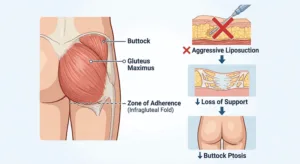
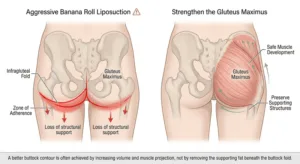
The area beneath the buttock is commonly referred to as the banana roll.
To many patients, it appears to be nothing more than an unwanted pocket of fat.
From an anatomical perspective, however, it is much more complex.
This region represents the transition between the buttock and the posterior thigh.
Within this transition lies the infragluteal fold, one of the body’s natural contour landmarks.
This fold is reinforced by dense fascial attachments known as the Zone of Adherence.
These fibrous structures firmly anchor the skin to the deep fascia and underlying tissues.
Their function is not cosmetic.
Their function is structural.
They help maintain:
- the natural position of the buttock,
- the definition of the lower buttock border,
- and the smooth transition between the buttock and the posterior thigh.
In other words,
this tissue exists because the body needs it.
It is part of the natural support system—not simply excess fat waiting to be removed.
Dr. Jeon’s Note
“One of the biggest mistakes in body contouring is assuming that every fat deposit is a surgical target.
Some structures exist for an important anatomical reason.
Understanding what should be preserved is just as important as knowing what can be removed.”
Modern Lifestyle Has Changed Our Glutes
Human anatomy evolved under conditions very different from modern life.
For thousands of years, humans walked long distances, climbed, squatted, lifted heavy objects, and performed physically demanding daily activities.
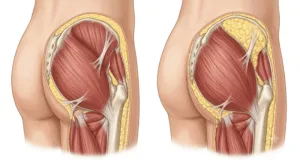
The gluteus maximus—the largest muscle in the human body—was constantly engaged.
Today, however, our daily lives have changed dramatically.
Millions of people spend eight to ten hours each day sitting.
Office work, prolonged computer use, driving, studying, and other sedentary activities have become the norm.
As a result, sports medicine specialists frequently describe a phenomenon known as gluteal deconditioning, sometimes referred to as “gluteal amnesia.”
When the gluteus maximus is underused for many years, it gradually loses strength, tone, and volume.
The upper buttock becomes flatter.
Projection decreases.
Although the infragluteal fold itself remains anatomically unchanged, the reduced projection above it makes the banana roll appear more noticeable.
In many cases, the problem is not that there is too much fat beneath the buttock.
The problem is that there is less muscle above it.
Clinical Observation
During more than two decades of performing body contouring surgery, I have noticed a consistent clinical pattern.
Many women seeking banana roll liposuction have occupations that involve prolonged sitting—office workers, administrators, accountants, bankers, designers, programmers, customer service representatives, and other desk-based professionals.
This does not mean that office work causes the banana roll by itself.
Rather, prolonged sitting often contributes to reduced gluteal muscle activation and gradual loss of upper buttock projection.
When that happens, patients naturally focus on the tissue beneath the buttock because it becomes more visually prominent.
However, treating only what is visually prominent does not necessarily solve the anatomical problem.
Dr. Jeon’s Note
“When I examine a patient requesting banana roll liposuction, I rarely begin by looking at the banana roll itself.
Instead, I first evaluate the volume, projection, and strength of the gluteus maximus.
In many office workers who spend long hours sitting, the primary issue is not excessive fat beneath the buttock.
It is insufficient muscle volume above it.
Once you understand that anatomy, the treatment strategy changes completely.”
Why We Choose to Preserve This Area
Patients are often surprised when I explain that removing fat can sometimes make the body look worse rather than better.
Aggressive liposuction beneath the infragluteal fold may temporarily reduce fullness.
However, excessive removal of tissue in this region may weaken the natural support system that helps maintain the lower contour of the buttock.
Potential long-term consequences may include:
- Loss of lower buttock support
- Flattening of the inferior buttock
- A lower or less youthful buttock appearance
- Loss of the natural infragluteal definition
- An unnatural transition between the buttock and the posterior thigh
These changes do not necessarily become obvious immediately after surgery.
Some patients initially appear improved, only to notice a gradual loss of contour months or years later as soft tissue support changes over time.
This is one of the reasons experienced body contouring surgeons approach this region with great caution.
Sometimes the best surgical decision is not to remove tissue.
It is to preserve it.
Dr. Jeon’s Note
“Before removing fat, I always ask myself one question:
What function does this tissue serve?
If preserving that tissue is more likely to produce a beautiful, long-lasting result, I preserve it.
Surgery should improve anatomy—not fight against it.”
Why Before-and-After Photos Can Be Misleading
Patients naturally trust photographs.
Unfortunately, photographs rarely tell the complete surgical story.
A single before-and-after image cannot reveal:
- whether surrounding areas such as the flanks, hips, or posterior thighs were also treated,
- whether fat grafting was performed simultaneously,
- whether posture, pelvic tilt, lighting, or camera angle changed,
- whether the photographs were taken months or years apart,
- or whether the patient’s anatomy was comparable to yours.
An impressive photograph is not evidence that a particular operation is appropriate for every patient.
In aesthetic surgery,
anatomy should always guide decision-making—not marketing.
If We Do Not Remove It, What Is the Better Solution?
Patients often ask,
“If you don’t remove this area, how can I achieve a rounder, more lifted buttock?”
The answer is surprisingly simple.
Rather than weakening the natural support beneath the buttock,
I prefer to improve the projection above it.
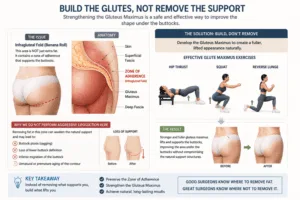
The first recommendation is almost always strengthening the gluteus maximus through targeted exercise.
As muscle volume increases, the upper buttock projects farther posteriorly.
The banana roll often becomes less noticeable—not because tissue beneath it has been removed, but because the overall contour has improved naturally while preserving the body’s supporting structures.
For patients who require greater volume enhancement, fat grafting may be considered.
In selected cases with insufficient donor fat, gluteal implants may also be appropriate.
However, both procedures require substantially longer recovery, more postoperative care, and greater patient commitment than conventional liposuction.
Neither should be viewed as a quick cosmetic solution.
Instead, they should be selected only after careful evaluation of the patient’s anatomy, lifestyle, expectations, and willingness to undergo the recovery process.
Dr. Jeon’s Note
“Sometimes adding volume is far more anatomical than removing tissue.
My goal is never simply to remove fat.
My goal is to create a natural contour that still looks beautiful five, ten, or even twenty years after surgery.”
The Philosophy Behind Every Procedure at Evita Clinic
At Evita Clinic, we believe body contouring should never be reduced to simply removing visible fat.
Every ligament has a purpose.
Every fascial attachment exists for a reason.
Every transition zone contributes to the harmony of the human body.
Good surgeons know where fat can be removed.
Great surgeons also know where it should be preserved.
This philosophy guides every operation I perform.
Because successful body contouring is not measured by how much fat has been removed.
It is measured by how naturally the body heals.
And by how well those results endure over time.
Final Thoughts
The banana roll is not merely a pocket of fat.
It is part of a sophisticated anatomical support system that helps maintain the natural shape, position, and elegance of the buttock.
Aggressive liposuction beneath the buttocks may look attractive in advertisements.
It may even produce an impressive early photograph.
But surgery should never be judged by the first postoperative picture.
It should be judged by how the anatomy functions—and how the body looks—years later.
At Evita Clinic, we do not simply remove fat.
We preserve anatomy.
Because anatomy—not marketing—creates beautiful results that last.