“How Many Kilograms of Fat Can You Remove?”
This is probably the most common question I hear during consultations.
“How many kilograms of fat can you remove?”
It’s a reasonable question—but it’s actually the wrong question.
After performing thousands of body contouring procedures, I’ve learned that the best liposuction results are never defined by the number of kilograms removed.
They are defined by how beautifully the body is reshaped.
Liposuction is not a treatment for obesity.
It is a procedure designed to improve body proportions, refine contours, and create balance.
“A successful liposuction is not the one that removes the most fat. It’s the one that creates the most beautiful body contour.”
— Dr. Francis Jeon

The Mirror Matters More Than the Scale
Many patients step onto the scale immediately after surgery.
But the truth is…
The mirror tells a much more important story than the scale.
Removing 3 kg of fat from the wrong areas may produce very little visual improvement.
Removing the same 3 kg strategically can create
- a narrower waist,
- smoother flanks,
- a cleaner back contour,
- and a more balanced body proportion.
Liposuction is not about making you lighter.
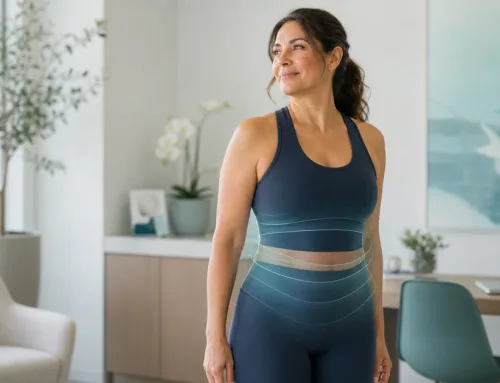
It is about making your body look more harmonious.
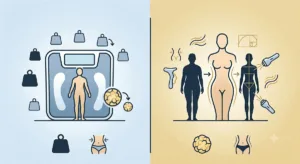
Why Can’t We Predict Exactly How Much Fat Will Be Removed?
One of the biggest misconceptions about liposuction is that every patient’s fat behaves the same way.
It doesn’t.
Two patients may have
- the same BMI,
- the same body weight,
- and almost identical waist measurements,
yet their fat can be completely different.
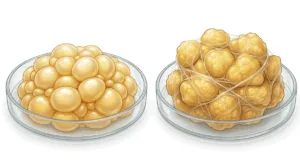
Some patients have soft fat that separates easily and is removed smoothly.
Others have dense, fibrous fat tightly bound by connective tissue.
This difference is influenced by
- genetics,
- sex,
- age,
- fat distribution,
- previous inflammation,
- and weight fluctuations.
That is why no experienced surgeon can honestly promise an exact number of kilograms before surgery.
An Experienced Surgeon Can Feel the Difference
One thing patients rarely realize is that we begin understanding the characteristics of the fat almost immediately after surgery starts.
As the tumescent solution is injected, the tissue begins to “talk” to the surgeon.
Through the feel of the cannula and the resistance of the tissue, we can often tell
- whether the fat is soft,
- whether significant fibrosis is present,
- whether the fat will separate easily,
- or whether aggressive suction could cause unnecessary bleeding.
This is not something that can be measured on a scan.
It comes from surgical experience.
Liposuction is not a procedure performed according to numbers.
It is a procedure guided by continuous judgment.
“Surgery should never chase a number. It should pursue a shape.”
— Dr. Francis Jeon
Is Removing More Fat Always Better?
Absolutely not.
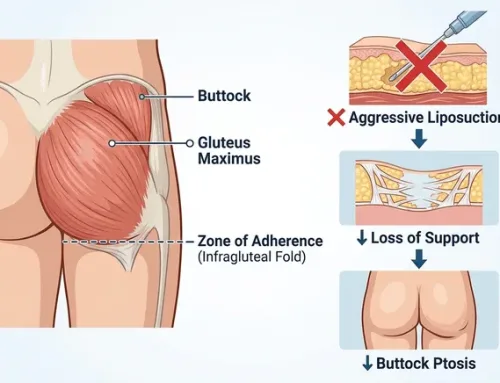
Aggressively removing dense fat can increase the risk of
- bleeding,
- excessively thin skin,
- fibrosis,
- adhesions,
- and contour irregularities.
Many complications in liposuction happen because someone tried to remove just a little more fat.
Good liposuction is not about removing the maximum amount.
It is about removing the right amount.
Knowing When to Stop Is One of the Most Important Surgical Skills
One of the greatest differences between an experienced body contouring surgeon and an inexperienced one is knowing when to stop.
During surgery there are warning signs.
The skin begins to feel too thin.
The aspirated fat contains increasing amounts of blood.
The tissue becomes excessively firm.
These are moments when experience matters.
Sometimes it is far better to finish the operation slightly conservatively and perform a small touch-up later if necessary.
Once too much fat has been removed,
- depressions,
- waviness,
- fibrosis,
- and severe adhesions
can become extremely difficult to correct.
Preventing these problems is always easier than treating them.
“The most skilled surgeon is not the one who removes the most fat. It is the one who knows exactly when to stop.”
— Dr. Francis Jeon
Liposuction Does Not Remove Fat Like a Tummy Tuck
Many people imagine liposuction as removing large blocks of fat.
In reality, it works very differently.
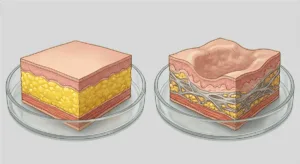
A tummy tuck removes skin and fat together.
Liposuction does not.
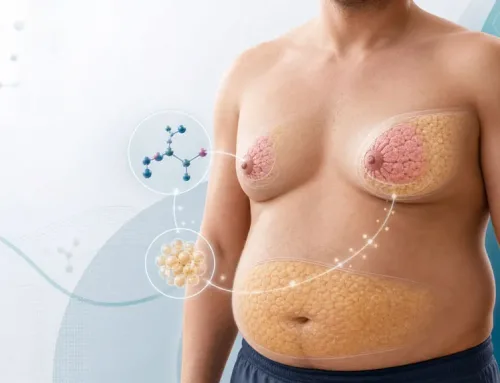
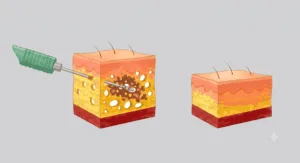
Instead, a thin cannula passes repeatedly through the fatty layer, creating countless tiny tunnels—almost like Swiss cheese.
Different cannulas are selected depending on the patient’s body shape and the characteristics of the fat.
Some fat cells are removed immediately.
Others are injured during the procedure and are gradually broken down and cleared away by the body’s natural healing process over the following weeks and months.
That is why your final result is not visible on the day of surgery.
Why Does Body Fat Continue to Decrease After Surgery?
Imagine that approximately 2 kg of fat is removed during surgery.
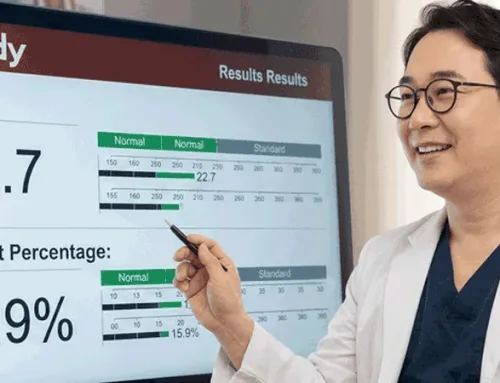
Several months later, an InBody analysis often shows a total body fat reduction of 5–6 kg.
Why?
Because body contouring is more than simple fat removal.
The final result comes from several processes working together:
- Fat physically removed during surgery.
- Fat cells naturally broken down during healing.
- Increased activity and healthier habits after patients begin seeing their new shape.
This is why postoperative care is just as important as the surgery itself.
Compression garments, walking, lymphatic drainage, exercise, and healthy nutrition all contribute to the final outcome.
Designing a Body Is More Important Than Measuring Fat
Some clinics routinely perform ultrasound examinations before liposuction.
Ultrasound certainly has value in selected situations, such as evaluating hernias or unusual abdominal conditions.
However, in cosmetic body contouring, ultrasound can measure fat thickness.
It cannot tell us how to create a beautiful body.
What matters most is design.
Shoulders.
Waist.
Pelvis.
Leg proportions.
The patient’s personal aesthetic goals.
Every area requires a different strategy.
Some areas should be reduced more.
Others should intentionally be preserved.
Creating beautiful proportions is far more important than removing the greatest amount of fat.
Our Philosophy at Evita Clinic
We never judge a successful liposuction by the number of kilograms removed.
We judge it by
- natural body proportions,
- smooth contours,
- long-term patient satisfaction,
- and above all,
- patient safety.
Liposuction is not about removing fat.
It is about designing the human body.
The question should never be
“How much fat was removed?”
Instead, it should be
“How beautifully was the body reshaped?”
“In body contouring, what you leave behind is often more important than what you remove.”
— Dr. Francis Jeon
At Evita Clinic, we don’t chase numbers. We create balance.