FTM Top Surgery – Free Nipple Graft Healing at 13 Days
What the dark crust over a nipple graft is, and what an early photograph can and cannot tell you.
- Procedure
- Double incision mastectomy with free nipple grafting
- Incision
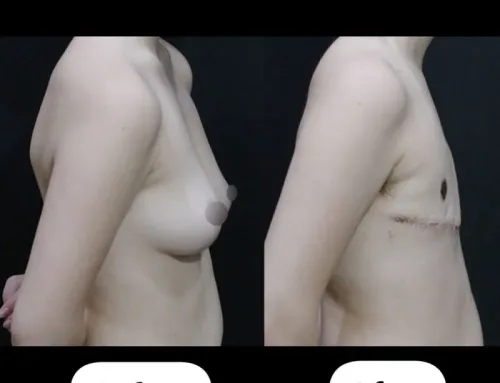
- Horizontal, along the lower chest
- Photographs
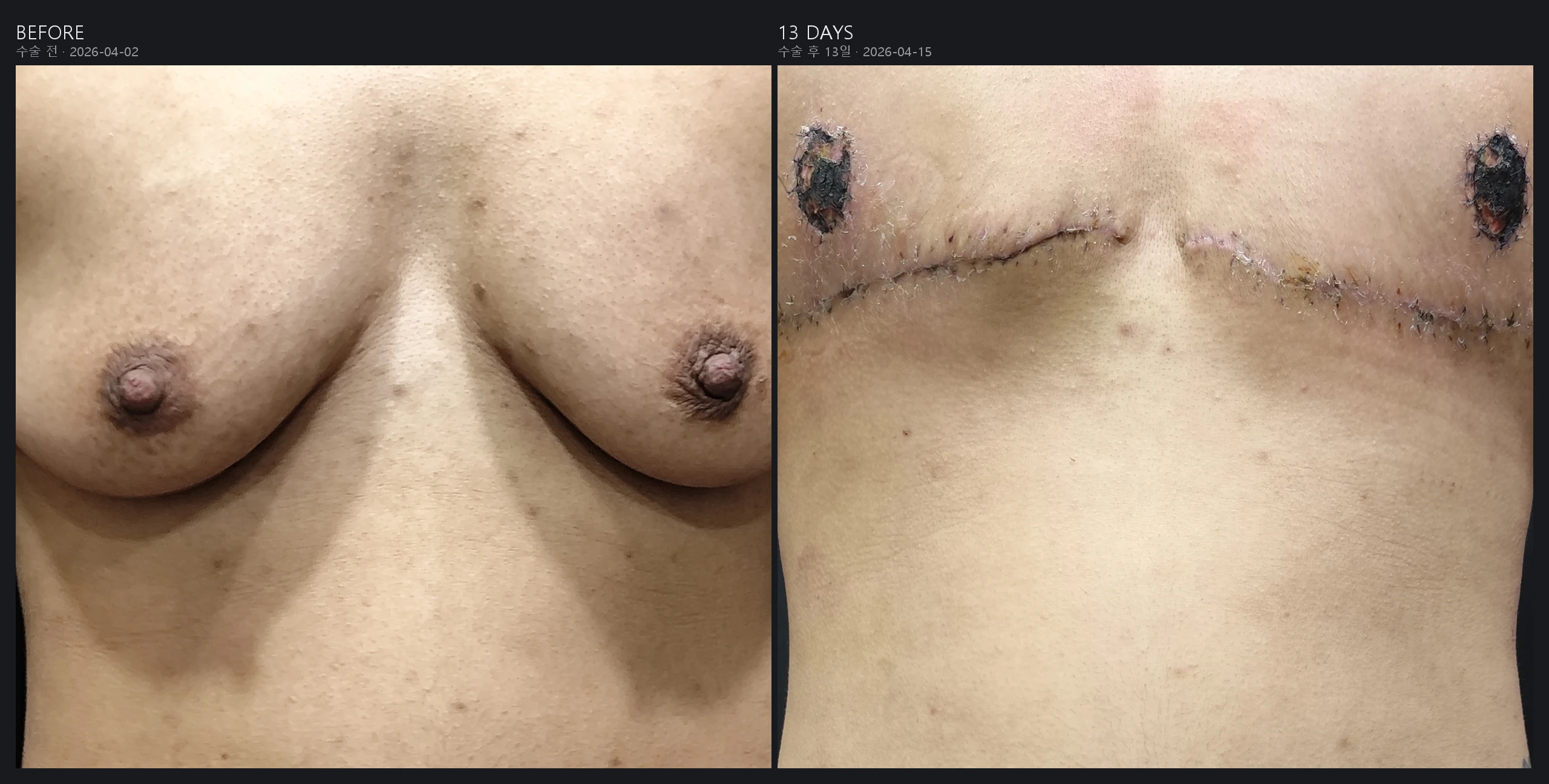
- Before surgery and 13 days after
- Stage shown
- Grafts still crusted; crusts had not yet separated
What the dark crust is
In a double incision with free nipple grafting, the nipple is removed, resized and put back as a graft. A graft arrives with no blood supply of its own and has to take one up from the tissue underneath it.
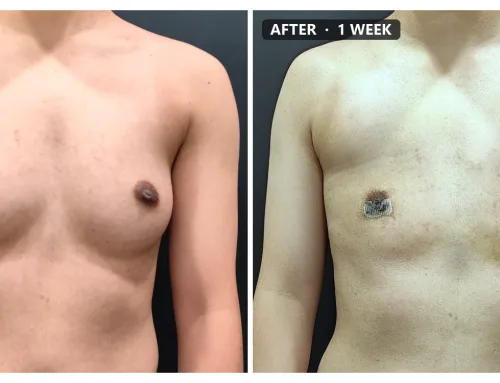
While that is happening the surface of the graft is covered by a dark crust. At around two weeks that crust looks its worst — almost black, firm, with the sutures still in place. Its presence at this stage is the expected course, not a complication.
Almost every patient who searches for photographs at this stage is frightened by what they see. The crust is the part of the graft that was never going to survive; the graft is healing underneath it.
Evita Clinic
What happens next
The crust usually separates on its own at around two to three weeks. It should not be picked off. Underneath, the pigment appears gradually and continues to settle in colour and texture for months afterwards.
Partial loss of graft pigment is possible and is a recognised outcome of free nipple grafting. It cannot be predicted from a photograph at this stage, in either direction.
What this photograph can and cannot tell you
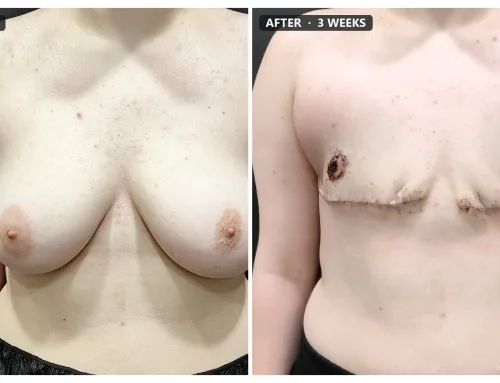
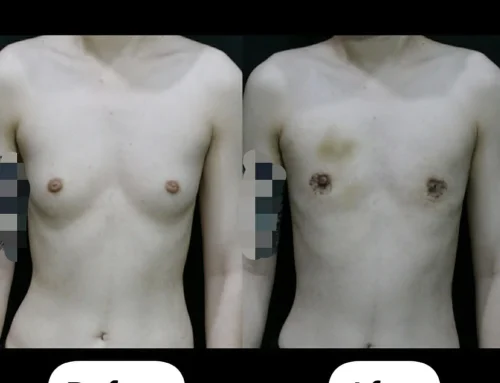
It can show the chest contour at thirteen days, the position and line of the incision, and what the grafts genuinely look like at this point in recovery.
It cannot show how the grafts finally looked. These photographs were taken before the crusts had separated, so the final appearance of the nipples is not visible here and is not claimed.
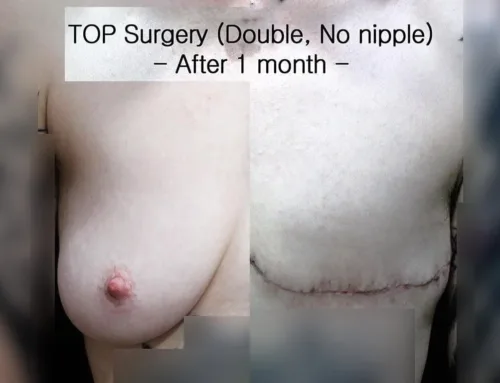
For a chest photographed after the crusts had separated, see our double incision case at three weeks. That is a different patient; healing timelines vary between individuals.
- A free nipple graft has no blood supply when it is placed and must take one up.
- The dark crust at around two weeks is expected, not a sign of failure.
- The crust separates on its own at roughly two to three weeks and should not be picked.
- Pigment settles over months; an early photograph cannot predict the final appearance.
About these images
Both frames are cropped identically and shown at the same scale. Scale was verified by measuring shoulder span, which this operation does not change, at five separate levels; the frames are aligned on the sternal notch. Nothing has been stretched, reshaped or retouched.
This patient is extensively tattooed, so the crop is drawn tightly to keep identifying ink out of frame rather than painting over it. Only the front view is published.
Results vary depending on individual anatomy, healing response, lifestyle factors and postoperative care. These images are provided for informational purposes only and do not guarantee specific results.