
Body Lift Surgery Guide
Recovery after abdominoplasty (tummy tuck) is a gradual healing process. Proper wound care, compression, activity control, and careful protection of the lower abdominal incision and umbilicus are essential for a safe recovery and a stable long-term result.
Most Important Notes
- Wear your compression garment exactly as instructed. Compression supports the healing tissues, controls swelling, and helps reduce movement between tissue layers.
- Protect your umbilicus (belly button). The umbilicus has its own blood supply and requires careful observation during early healing.
- Avoid strenuous activity for approximately one month. Heavy lifting, abdominal exercise, running, and sudden twisting or stretching may increase tension across the incision.
- Walk regularly, but avoid overactivity. Gentle walking supports circulation, while excessive activity may increase swelling and fluid accumulation.
- Keep the incision and umbilicus clean and dry. Persistent moisture may soften the skin and delay wound healing.
- Continue protecting your abdomen during Weeks 2–3. Feeling better does not mean that the deeper tissues have completely healed.
Why the Umbilicus Needs Special Care
During a full tummy tuck, the umbilicus remains attached to the abdominal wall while the surrounding abdominal skin is repositioned. A new opening is created in the skin, and the umbilicus is carefully secured within this opening.
Although the belly button usually heals well, it is one of the more delicate areas during early recovery. Its curved and recessed shape may also retain moisture more easily than the lower abdominal incision.
Mild swelling, firmness, scabbing, and temporary changes in shape or sensation are common during early healing.
- Avoid unnecessary or concentrated pressure directly over the belly button.
- Follow all dressing instructions carefully.
- Keep the area clean and dry.
- Do not remove dressings, scabs, or sutures yourself.
- Do not apply ointment, disinfectant, powder, or scar products unless instructed.
- Contact Evita Clinic if you notice increasing redness, persistent drainage, foul odor, wound separation, or dark discoloration.
Why the Lower Abdominal Incision Is Under Tension
During tummy tuck surgery, excess abdominal skin is removed and the remaining skin is tightened. As a result, the long lower abdominal incision is naturally exposed to tension during the first several weeks of healing.
Standing upright, sitting, coughing, laughing, getting out of bed, reaching, twisting, and stretching may all place additional stress on the incision. This tension gradually decreases as the tissues heal and soften.
- Stand more upright gradually during the first several days.
- Do not force your abdomen into a fully stretched position.
- Support your abdomen when coughing or sneezing.
- Use your arms and legs when getting in and out of bed.
- Continue wearing your compression garment as instructed.
- Avoid lifting heavy objects.
- Avoid sudden twisting, reaching, or abdominal stretching.
Weeks 2–3: Continue Protecting Your Healing Abdomen
During the second and third weeks after surgery, most patients begin to feel significantly better. Pain decreases, swelling improves, and normal daily activities become easier.
However, the deeper tissue layers are still healing. This is an important period for preventing excessive swelling, wound tension, and seroma formation.
Why can problems occur during Weeks 2–3?
- Patients naturally become more active because they feel better.
- The abdominal skin and deeper tissue layers have not yet fully adhered.
- Excessive walking, prolonged standing, heavy housework, or lifting may increase tissue movement.
- Repeated movement between tissue layers may contribute to fluid accumulation.
- The lower abdominal incision and umbilicus remain under tension.
How can you reduce these risks?
- Continue wearing your compression garment.
- Take several short walks rather than one long walk.
- Increase your activity gradually.
- Avoid heavy lifting, strenuous housework, and abdominal exercise.
- Change position regularly rather than sitting or standing for prolonged periods.
- Continue following your surgeon’s activity restrictions even when you feel well.
Remember: Feeling better does not mean that the deeper tissues have completely healed. Continue protecting your abdomen throughout the first month.
Compression Garment
Your compression garment is one of the most important components of tummy tuck recovery. It provides support to the abdominal tissues while they heal and helps control excessive movement and swelling.
- Wear your compression garment continuously for approximately 4 weeks unless instructed otherwise.
- Compression helps control postoperative swelling.
- It supports the abdominal skin and deeper tissues during healing.
- Most importantly, compression helps reduce shearing movement between the tissue layers.
- Reducing tissue movement may help lower the risk of fluid accumulation and seroma.
- Compression may also reduce unnecessary tension across the lower abdominal incision.
- Do not stop wearing the garment simply because your pain or swelling has improved.
- Make sure the garment does not fold, roll, or create concentrated pressure over the incision or umbilicus.
- Contact Evita Clinic if the garment causes severe pressure, blistering, skin discoloration, or increasing pain.
The garment should feel supportive and evenly fitted. It should not cause sharp pain, breathing difficulty, or concentrated pressure on one area.
Walking & Daily Activity
Gentle walking is encouraged soon after surgery because it improves circulation and helps reduce the risk of blood clots. However, more activity is not always better during early recovery.
- Take several short walks each day.
- Increase your walking distance gradually.
- Rest if swelling, tightness, or discomfort increases.
- Avoid long shopping trips and prolonged standing.
- Avoid heavy housework, lifting, pushing, and pulling.
- Avoid running, abdominal exercise, and vigorous exercise during the first month.
- Do not repeatedly stretch your abdomen to test how straight you can stand.
Gentle movement supports circulation and recovery. Excessive activity may increase swelling, wound tension, and the risk of seroma formation.
Dermabond Prineo® Skin Closure System
Your lower abdominal incision is usually protected with the Dermabond Prineo® Skin Closure System. This system combines medical skin adhesive with a self-adhering mesh to protect and support the incision during early healing.
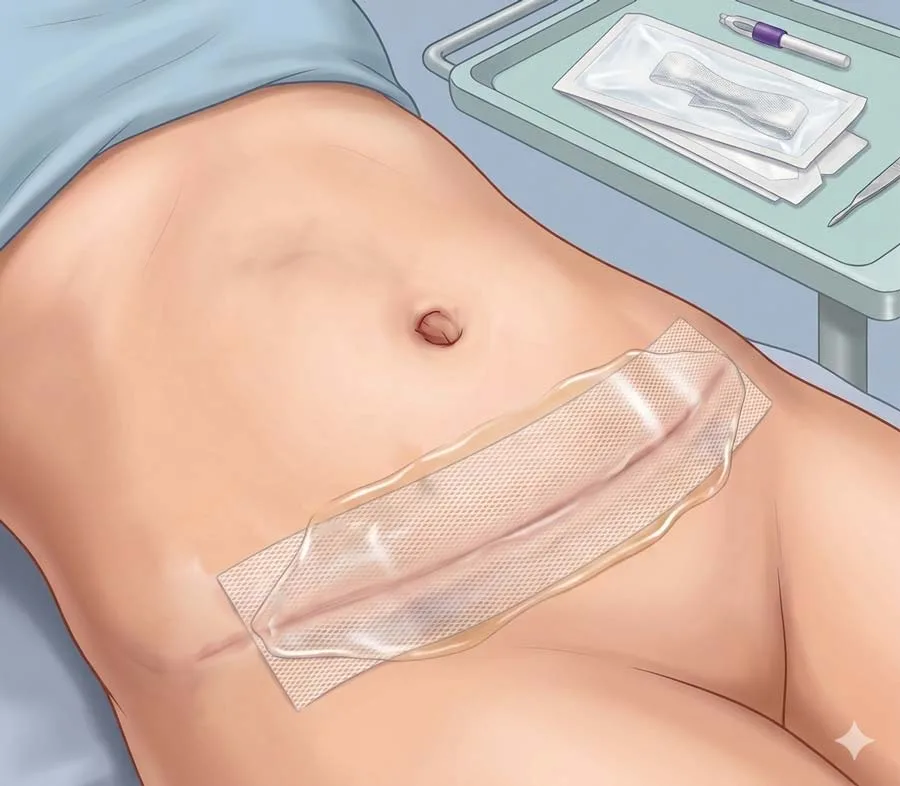
- Do not remove Dermabond Prineo® yourself.
- No routine dressing change is required over the protected incision.
- Do not rub, scratch, peel, pull, or trim the mesh.
- Do not apply ointment, moisturizer, scar gel, silicone products, or disinfectant over the mesh.
- Slight lifting at the outer edges may occur and is usually not a problem.
- Do not place additional adhesive tape directly over loose Prineo® unless instructed.
- Your surgeon will determine when the dressing is ready to be removed.
- Contact Evita Clinic if the mesh becomes widely detached or if you notice wound opening, increasing redness, or drainage beneath it.
Showering
Showering is usually allowed approximately 2–3 days after surgery unless you have received different instructions.
- Allow clean water to flow gently over the incision.
- Do not scrub the incision or Dermabond Prineo®.
- Do not use a sponge, washcloth, or exfoliating product directly over the surgical areas.
- Gently pat the incision dry with a clean towel.
- Carefully dry the umbilicus after every shower.
- Do not leave wet gauze or a damp garment against the skin.
- Avoid bathtubs, swimming pools, hot tubs, and saunas until approved by your surgeon.
Drain Removal Site Care
Surgical drains remove fluid during the early healing period and help reduce fluid accumulation beneath the abdominal skin. They are removed when the drainage has decreased to an appropriate level.
- Keep each drain removal site clean and dry.
- Keep the waterproof dressing in place for the period instructed by Evita Clinic.
- A small amount of clear, pink, or blood-tinged drainage may occur temporarily after drain removal.
- Replace any wet or soiled gauze promptly.
- Do not apply scar gel or silicone products to an open drain site.
- Contact Evita Clinic if you notice persistent bleeding, increasing redness, pus, foul odor, or worsening pain.
Seroma After Tummy Tuck
A seroma is a collection of clear body fluid beneath the abdominal skin. It may occur after the drains have been removed while the deeper tissue layers are still healing.
Seromas commonly become noticeable during the second or third postoperative week, when patients feel better and begin increasing their activity.
Possible signs of a seroma
- A new or enlarging area of swelling
- Asymmetry of the lower abdomen
- A soft or fluid-like sensation beneath the skin
- A sensation of fluid movement when changing position
- Increasing tightness, pressure, or discomfort
How can you reduce the risk?
- Continue wearing your compression garment.
- Walk regularly, but avoid excessive or prolonged activity.
- Avoid heavy lifting and abdominal exercise.
- Avoid prolonged sitting or standing without changing position.
- Continue protecting your abdomen even when your pain and swelling have improved.
Compression helps support the healing tissues and reduce movement between tissue layers. However, compression cannot prevent every seroma.
If you suspect fluid accumulation, send clear photographs or a short video to Evita Clinic. Some seromas may require examination and aspiration.
Learn more: Seroma after Tummy Tuck – What It Is and How to Manage It
Daily Umbilical Care
Check your belly button every day during the early healing period. Mild swelling, firmness, scabbing, or temporary changes in shape are common.
- Keep the umbilicus clean and dry.
- Carefully dry the inside and surrounding skin after showering.
- Do not pick at scabs or healing tissue.
- Do not insert cotton swabs deeply into the belly button unless instructed.
- Do not apply ointment, disinfectant, powder, or scar products unless recommended by Evita Clinic.
- Make sure your compression garment does not place concentrated pressure directly over the umbilicus.
- Follow any specific dressing instructions provided by your surgeon.
Contact Evita Clinic if you notice increasing redness, persistent drainage, foul odor, worsening pain, wound separation, or dark brown, purple, gray, or black discoloration.
After Dermabond Prineo® Removal
Once Dermabond Prineo® has been removed and the incision is stable, Steri-Strips are usually applied to continue supporting the lower abdominal incision.
At this stage, the incision may appear pink or red and may feel firm, tight, uneven, or temporarily numb. These changes are common during early scar maturation.
Steri-Strip Support
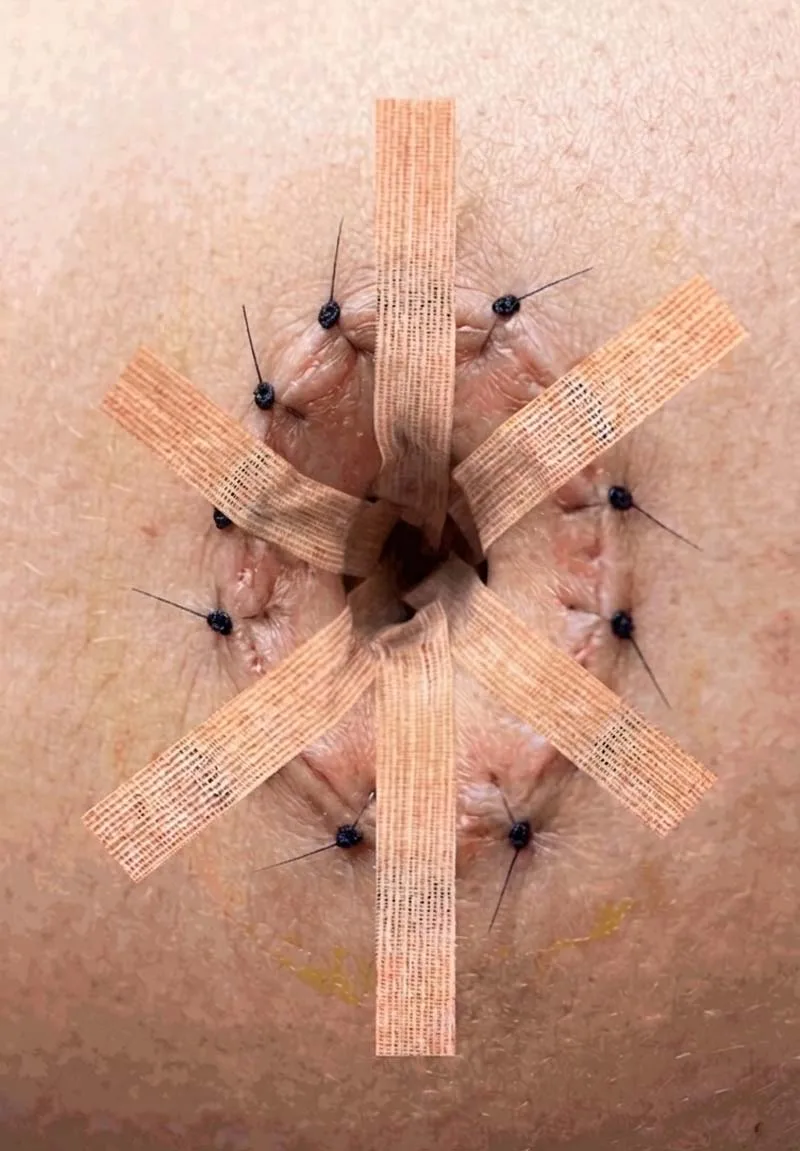
Steri-Strips provide external support to the healing incision and help reduce the mechanical forces that may cause a scar to widen.
- Apply each Steri-Strip perpendicular to the incision.
- Allow each strip to cross the incision at approximately a 90-degree angle.
- Leave small spaces between the strips for ventilation.
- Do not stretch the strips excessively during application.
- Apply the strips only to clean, completely dry skin.
- Keep the strips clean and dry.
- Replace them only when they become loose or detach naturally.
- Do not remove and replace them every day.
- Do not apply Steri-Strips over an open wound, drainage, blister, or irritated skin.
- Continue using Steri-Strips for several weeks or longer when instructed.
Steri-Strips are not simply protective tape. They reduce tension across the incision and help support the scar while it becomes stronger.
If a Small Wound Opening Occurs
Small areas of delayed healing may occasionally develop along the lower abdominal incision or around the umbilicus. This does not automatically mean that the area is infected or that the surgery has failed.
Small wound openings may be related to tension, swelling, moisture, friction, increased activity, reduced local circulation, or individual healing differences.
- Send clear photographs to Evita Clinic for evaluation.
- Keep the area clean and dry.
- Reduce activity and unnecessary stretching.
- Continue appropriate compression unless it causes direct pressure or friction over the wound.
- Use Betadine®, antibiotic ointment, gauze, or another dressing only when instructed.
- Do not apply silicone gel, scar ointment, or silicone sheets over an open wound.
- Do not place Steri-Strips directly over drainage or irritated skin unless specifically instructed.
- Do not pick at scabs, yellow fibrin, or healing tissue.
Scar treatment should begin only after the wound has completely closed and the skin is stable.
Scar Care After Tummy Tuck
Scar healing is a gradual biological process. Even after the incision has completely closed, the lower abdominal and umbilical scars continue to change and mature for many months.
Long-term scar treatment should begin only after the incision is completely closed, dry, and stable.
- Continue using Steri-Strips for several weeks or longer as instructed.
- Do not apply scar gel, silicone products, or ointment to an open wound, scab, drainage, blister, or irritated skin.
- Silicone sheets may be useful for the long, relatively flat lower abdominal scar.
- Silicone gel may be more convenient around the belly button and other curved areas.
- Begin scar massage only after the incision has completely healed and when advised by Evita Clinic.
- Protect the lower abdominal and umbilical scars from direct sunlight for at least 6 months.
- Remember that scars may remain pink, red, firm, itchy, or slightly raised during the first several months.
- Most scars continue to soften, flatten, and fade for approximately 12–18 months.
For detailed instructions about Steri-Strips, silicone therapy, scar massage, sun protection, raised scars, and long-term scar maturation, please review:
Simple Healing Timeline
Early Recovery
Swelling and tightness are usually greatest during the first week. Walk gently, wear your compression garment, and follow all incision, drain, and umbilical dressing instructions.
Continue Protecting Your Abdomen
Most patients feel much better during this period, but the deeper tissue layers are still healing. Continue compression and avoid excessive walking, lifting, housework, and abdominal strain.
Gradual Return to Activity
Daily activity can usually be increased gradually. More strenuous exercise should resume only according to your surgeon’s instructions and your individual healing progress.
Improving Contour
Swelling and firmness continue to decrease. The abdomen gradually becomes softer, and the scars begin to flatten and fade.
Long-Term Result
Most swelling has resolved and the abdominal contour appears more natural. Scar maturation continues beyond this period and may take 12–18 months or longer.
What Is Normal During Recovery?
During tummy tuck recovery, it is common to notice:
- Swelling and bruising of the abdomen
- Firmness beneath the skin
- Tightness across the lower abdomen
- Difficulty standing completely upright during the first several days
- Temporary numbness or altered sensation of the lower abdomen
- Swelling, firmness, or scabbing around the belly button
- Mild pulling sensations when standing or stretching
- Uneven swelling between the right and left sides
- Firmness or temporary irregularity along the incision
- Gradual improvement over several weeks to months
These changes are generally part of normal healing. Swelling, firmness, sensation, and abdominal contour improve gradually rather than all at once.
Frequently Asked Questions
When can I stand up straight?
Most patients gradually stand more upright over the first 1–2 weeks. Do not force yourself to stand completely straight if doing so causes significant pulling or discomfort.
How long should I wear my compression garment?
Most patients wear their compression garment continuously for approximately 4 weeks unless instructed otherwise. Some patients may need longer compression depending on swelling, seroma risk, and healing progress.
When can I shower?
Showering is usually allowed approximately 2–3 days after surgery unless you have received different instructions. Gently dry the incision, drain sites, and umbilicus afterward.
Why does my abdomen feel tight?
Tightness is expected because excess skin has been removed and the abdominal skin and deeper tissues have been tightened. It usually improves gradually over several weeks to months.
Is it normal for my abdomen to feel firm?
Yes. Temporary firmness is common as swelling resolves and scar tissue develops beneath the skin. The abdomen gradually softens during recovery.
Why is one side more swollen than the other?
Mild asymmetry of swelling may occur during early recovery. However, rapidly increasing or fluid-like swelling should be reported to Evita Clinic.
When can I drive?
You may drive when you are no longer taking sedating or narcotic pain medication, can sit comfortably, and can safely turn, brake, and control the vehicle without significant pain.
When can I exercise?
Gentle walking is encouraged soon after surgery. Running, strenuous exercise, abdominal workouts, and heavy lifting should usually be avoided for approximately one month or until approved by your surgeon.
When can I begin scar treatment?
Scar gel, silicone sheets, and scar massage should begin only after the incision has completely closed and the skin is dry and stable. Do not apply scar products to an open wound, scab, drainage, or irritated skin.
When will I see my final result?
The abdominal contour improves immediately after surgery, but swelling and firmness continue to change for several months. The long-term contour is generally assessed between 6 and 12 months, while scar maturation may continue for 12–18 months or longer.
When Should I Contact Evita Clinic?
Please contact Evita Clinic if you notice:
- Increasing or spreading redness around the incision or umbilicus
- Increasing warmth, swelling, or pain
- Persistent or active bleeding
- Pus or foul-smelling drainage
- Rapidly increasing or fluid-like abdominal swelling
- A sensation of fluid moving beneath the skin
- Rapidly enlarging wound separation
- Dark brown, purple, gray, or black discoloration around the umbilicus or incision
- High fever or chills
- Severe or worsening pain
- Shortness of breath, chest pain, or calf swelling
- Any concern about your wound, drain site, compression garment, or recovery
Important Note
Recovery after tummy tuck surgery is a gradual process. Most patients heal smoothly by wearing their compression garment, walking regularly, avoiding excessive activity, and following their postoperative instructions.
Feeling better does not always mean that the deeper tissues have completely healed. Continue protecting your abdomen during the first month, especially during Weeks 2–3, when increased activity may contribute to swelling or seroma formation.
Good scar care begins with good wound healing. Protecting the incision from tension, moisture, friction, smoking, and premature stretching is more important than applying multiple scar products too early.
Patience and consistent care during the early healing period are important for achieving the best possible long-term result.
Questions?
If you have questions about your recovery, compression garment, umbilical care, drain site, incision, seroma, Steri-Strips, or scar healing, please contact Evita Clinic.
We are happy to review clear photographs and provide postoperative guidance based on your healing progress.