Medical Insights · GLP-1 Weight Management
Why the quality, pace and maintenance of weight loss matter—and how to plan for loose skin without blaming yourself.
Can GLP-1 weight loss cause loose skin?
GLP-1 medications do not necessarily cause loose skin directly. However, substantial or rapid weight loss can reduce facial and body volume, making existing skin laxity more visible or leaving excess skin behind. The risk varies with the total amount lost, age, genetics, how long the skin was stretched, previous weight changes, pregnancy, smoking, nutrition, muscle support and other individual factors.
The goal is not to fear effective treatment. It is to plan the weight-loss phase, the landing phase and long-term maintenance as one continuous process.
Key points
- Wegovy, Zepbound, Mounjaro and Saxenda can produce clinically meaningful weight loss, but trial averages are not personal monthly targets.
- The scale cannot show whether the change came from fat, lean tissue, water or glycogen.
- Resistance exercise and adequate intake should begin during weight loss—not only after the goal weight is reached.
- Slower weight loss cannot guarantee that loose skin will be prevented, especially after major weight loss.
- If structural excess skin remains, exercise can improve the frame underneath it but cannot remove the skin itself.
- Evita Clinic generally advises about six months of stable weight before elective skin-removal body contouring.
In consultations, patients often tell me, “Someone I know lost 10 kilograms in one month. Why am I not losing that fast?” Once the scale begins to move, it is easy to feel that faster must be better.
I understand the attraction of that number. GLP-1–based treatments have changed obesity care and deserve recognition for results that were difficult to achieve with earlier medications. My concern is not the existence of these treatments. It is the competition that can grow around them.
Since 2009, I have performed body-contouring surgery and met many patients living with body changes after obesity and major weight loss. The recurring lesson is simple: the speed of weight loss alone does not define success.
How much weight do GLP-1 medications help people lose?
The results are substantial, but they need context. Liraglutide 3.0 mg produced an average 8.0% reduction at 56 weeks in the SCALE trial. Semaglutide 2.4 mg produced an average 14.9% reduction at 68 weeks in STEP 1. Tirzepatide produced average reductions of 19.5% with 10 mg and 20.9% with 15 mg at 72 weeks in SURMOUNT-1.1–3
Retatrutide, an investigational triple agonist, produced a reported average 28.3% reduction with 12 mg at 80 weeks in the 2026 TRIUMPH-1 topline announcement. It remains investigational and is not an approved weight-management medication. Regulatory timing can change.4
Average body-weight reduction reported in major trials
8.0%
14.9%
19.5%
20.9%
28.3%
Not a head-to-head ranking. These results come from different studies with different participants, durations, doses, lifestyle support and analysis methods. They are averages—not guaranteed outcomes or personal monthly targets. Retatrutide data shown here come from a company topline announcement and the medication is not approved.
Use the correct international drug names
- Liraglutide 3.0 mg
- Saxenda for chronic weight management.
- Semaglutide 2.4 mg
- Wegovy for weight management. In the United States, Ozempic is a semaglutide brand for type 2 diabetes.
- Tirzepatide
- Zepbound is the US weight-management brand; Mounjaro is the US diabetes brand and is also authorized for weight management in some other countries.
- Retatrutide
- An investigational triple agonist—not an approved medication in any country at the time of this review.
What does the scale fail to show during weight loss?
Body weight can change because of fat, lean tissue, water, glycogen and other tissues. “Lean mass” is not the same as skeletal muscle: it also includes water, organs and other non-fat tissue. A body-composition device cannot perfectly separate every compartment either, especially when hydration changes.
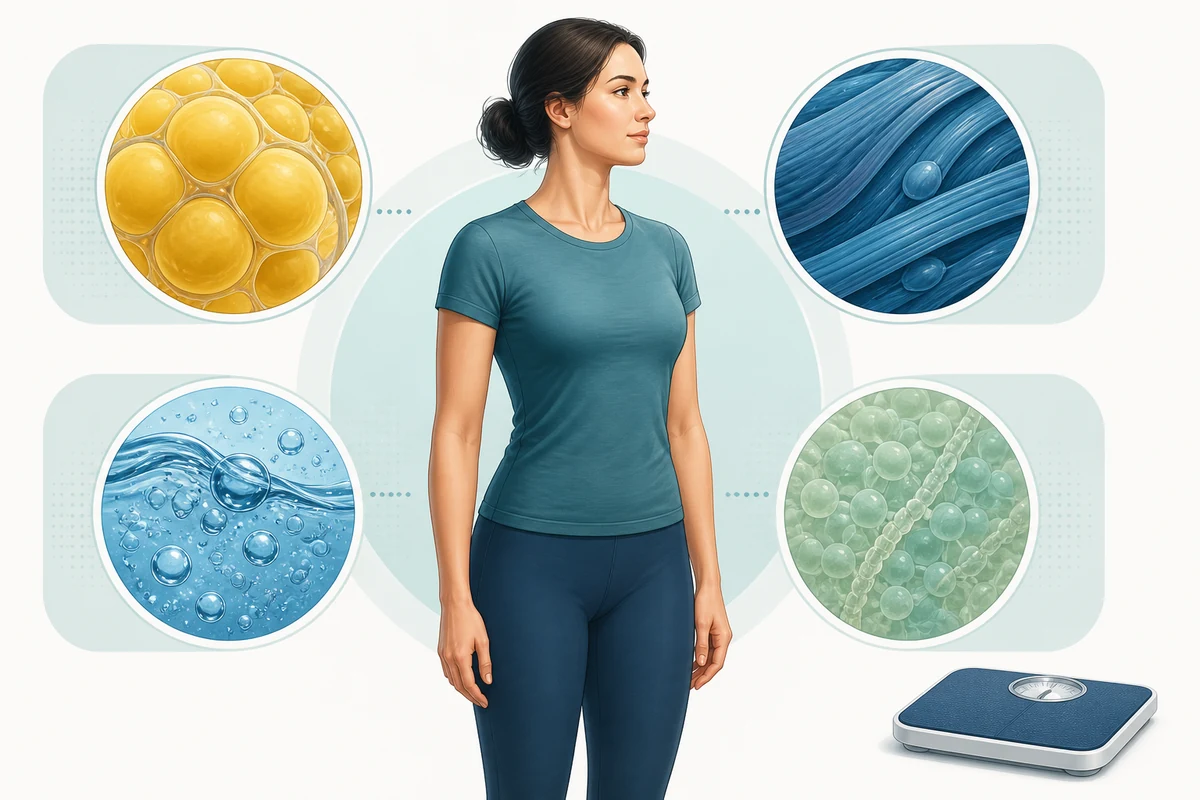
- Fat massThe primary tissue most patients intend to reduce.
- Lean tissueIncludes more than skeletal muscle.
- WaterCan shift rapidly and affect measurements.
- Stored energyGlycogen changes are linked with water change.
If appetite suppression greatly reduces the quantity and variety of food, some patients may struggle to obtain enough protein or micronutrients. This does not mean that the medication directly “drains” a specific vitamin or mineral. The concern is inadequate intake, persistent gastrointestinal symptoms or an existing deficiency that becomes harder to correct.5
Track the trend, not one isolated reading: weight and waist change, repeated body-composition measurements under similar conditions, actual strength, exercise performance, food and fluid intake, fatigue, dizziness, hair shedding and gastrointestinal symptoms.
Are muscle-preserving obesity medications being developed?
Yes—but they are investigational. In a 2026 phase 2 trial, adding bimagrumab, an activin type II receptor antibody, to semaglutide reduced the loss of lean mass compared with semaglutide alone. Another phase 2 trial found 1.9 kg less lean-mass loss at 24 weeks when the myostatin-targeting antibody apitegromab was added to tirzepatide.6,7
These studies do not mean that an approved “zero muscle loss” obesity medication is available. Lean-mass preservation is also not identical to proven improvement in long-term strength, mobility or safety. What they do show is an important change in research: future treatment quality may be judged by how much fat is lost, what function is preserved and how well the result is maintained—not by body weight alone.

Why can the face and body look looser after GLP-1 weight loss?
“Ozempic face” is a popular phrase, not a medical diagnosis. It describes facial hollowing, visible wrinkles or laxity that may become more noticeable when facial fat and soft-tissue volume decrease. It is not unique to Ozempic or semaglutide; similar changes can follow substantial weight loss by other methods.8
Loose skin is not explained by speed alone. The total amount of weight lost, age, inherited skin elasticity, how long the tissue was stretched, repeated weight cycling, pregnancy, smoking, sun exposure and the support from underlying tissue all matter. Patients who begin at a higher weight often lose a larger total volume and may have had stretched tissue for longer, increasing the chance that structural excess skin will remain.
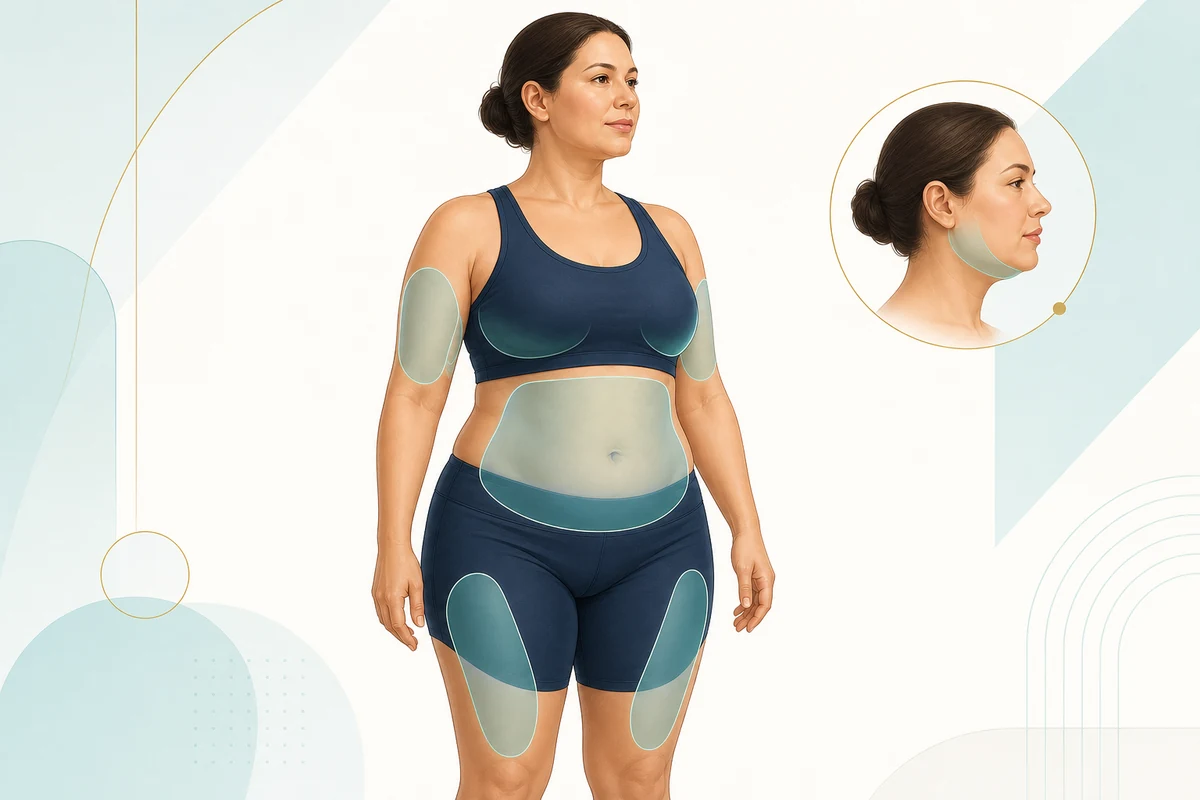
Do not blame yourself. Even a carefully supported weight-loss plan cannot guarantee that loose skin will be prevented. Large total weight loss, age, genetics and the original condition of the tissue may matter more than any single choice you made.
What is Dr. Jeon’s Clinical Soft-Landing Framework?
Since 2009, I have repeatedly seen patients reach an impressive number quickly and then face a second set of concerns: loss of strength, facial volume change, hair shedding, difficulty maintaining intake, or excess skin around the chest, abdomen, arms and thighs.
I have also used a GLP-1–based medication myself for about two years, adjusting my treatment plan as my weight, appetite, physical condition, exercise and maintenance goals changed. That experience helped me understand both the value of the medication and the temptation to chase a faster result.
My Clinical Soft-Landing Framework combines that personal perspective with body-contouring experience. It is designed to move from active weight loss into a maintainable landing rather than treating the lowest possible number as the finish line.
Dr. Jeon’s clinical framework—not a universal guideline
The monthly percentages below are not international prescribing guidelines, medication-dosing rules or proven thresholds for preventing loose skin. They are conservative discussion points that Dr. Jeon uses to identify when repeated rapid loss should trigger reassessment and when the focus should shift toward maintenance.
Active loss
During the early phase, a repeated monthly loss greater than about 5% of current weight is a reason to review intake, symptoms, function and the treatment plan—not a number to compete with.
Approaching the goal
Evita generally begins discussing the landing phase when BMI enters roughly the 25–30 range. This is a clinical reference range, not an ideal BMI or automatic surgical threshold.
Slow the descent
Near the goal, about 2% of current weight per month is used as a discussion point while greater attention shifts to strength, function and the ability to maintain.
Stable landing
Build a weight, eating pattern and activity routine that can be sustained. Reassess remaining skin only after the body has stopped changing substantially.
What do 5% and 2% mean for a 100 kg (220 lb) patient?
- 5% = 5 kg (11 lb)This is not a required monthly target. Repeatedly exceeding it prompts reassessment in Dr. Jeon’s framework.
- 2% = 2 kg (4.4 lb)This calculation illustrates the landing concept. The actual percentage is calculated from the patient’s current weight at that stage.
A meta-analysis comparing similar total weight loss found that gradual loss favored fat-mass reduction and preservation of resting metabolic rate, but did not find a significant difference in fat-free-mass change. That does not prove that losing slowly will preserve muscle or prevent loose skin in the long term.9
Medication dose or timing should never be changed to match these percentages without the prescribing clinician. They are a conversation framework, not a self-treatment protocol.
Will weight return after stopping a GLP-1 medication?
Weight regain is common after treatment stops, but there is no reliable universal rule that “half regain and half do not.” In the STEP 1 extension, participants regained about two-thirds of their previous semaglutide-associated weight loss on average during the year after withdrawal. That refers to the average amount regained, not the percentage of patients who failed, and it does not mean that every participant returned to baseline.10
Regain is influenced by appetite biology, lower energy requirements after weight loss, the treatment plan, food environment, sleep, stress, activity, strength, follow-up and whether another maintenance strategy is used. Obesity is a chronic disease. Some patients may need long-term medication or another ongoing strategy; regain is not proof of weak willpower.
There is encouraging evidence for planning exercise early. In a randomized trial and one-year post-treatment follow-up, participants who combined liraglutide with supervised exercise maintained weight and body composition better after treatment ended than those who received liraglutide alone.11 The study did not prove that an increase in basal metabolic rate was the single reason, and exercise does not guarantee zero regain.
What if significant loose skin is already present?
Mild laxity may look somewhat better after weight stabilizes and the underlying muscle frame improves. Skin also needs time after a major change. However, exercise, creams and medication cannot directly remove a substantial structural fold of excess skin.
When loose skin remains significant, skin-excision body contouring is a treatment that can remove it directly. Depending on the area, options may include:
Tummy tuck
Removes excess abdominal skin and may address abdominal-wall laxity when indicated.
Arm lift
Removes excess upper-arm skin through a scar matched to the extent of laxity.
Thigh lift
Addresses lax inner- or outer-thigh skin, friction and contour concerns.
Breast lift
Reshapes the breast envelope after volume loss, with or without another breast procedure.
Not everyone with loose skin needs surgery. A longer scar corrects a broader area but creates a larger wound and recovery burden. Some multi-area procedures are safer when staged rather than performed together.
When is the right time for skin-removal surgery?
The American Society of Plastic Surgeons Practice Parameter describes body-contouring surgery as ideally performed after stable weight has been maintained for two to six months. Evita Clinic generally advises about six months of stable weight before planning elective skin-removal surgery. A larger loss, bariatric surgery, continuing medication adjustment or incomplete recovery preparation may require a longer wait.12
Time alone is not enough. The active loss phase should be substantially complete, the current weight should be maintainable, and the patient should be prepared for the scar, recovery and—when necessary—a staged plan. Functional problems such as recurrent dermatitis, hygiene difficulty or impaired movement may change the priority and require individualized assessment.
Do GLP-1 medications have to be stopped before surgery?
Not automatically. Recommendations differ by country and institution. A 2024 US multi-society clinical guidance allows many patients without elevated delayed-gastric-emptying or aspiration risk to continue treatment, while emphasizing shared risk assessment. UK guidance also supports continuation with risk mitigation. A 2025 Australian and New Zealand recommendation supports continuation and recommends a 24-hour clear-fluid diet for all GLP-1 or GLP-1/GIP users before procedures involving anesthesia or sedation.13–15
Tell the prescribing clinician and Evita surgical team the exact medication, dose, schedule, last dose, recent dose escalation, gastrointestinal symptoms and whether it is used for diabetes. The decision to continue, pause and restart medication must follow the current surgical protocol and the individual plan—not a blog post.
Evita’s consultation starts before choosing an operation
“The fact that I can perform a surgery does not mean that surgery is the right next step today. Sometimes the better plan is to wait, stabilize the weight, improve readiness, reduce the surgical extent—or avoid surgery if possible.”
Dr. Francis Jeon
Frequently asked questions
Does Wegovy cause loose skin?
Wegovy does not necessarily damage or loosen skin directly. Significant volume loss can reveal existing laxity or leave excess skin, with risk influenced by total loss, age, elasticity, the duration of obesity and other individual factors.
Why can Mounjaro or Zepbound make the face look older?
Rapid or substantial facial fat and soft-tissue volume loss may make the cheeks or temples look hollow and existing wrinkles more visible. The effect is not unique to tirzepatide and can occur after major weight loss by other methods.
Can losing weight slowly prevent loose skin?
No pace can guarantee prevention. A manageable pace may make it easier to support intake, exercise and monitoring, but total weight loss, age, genetics and previous tissue stretching remain important.
How can I protect muscle while using a GLP-1 medication?
Begin resistance exercise and an individualized nutrition plan early. Monitor real strength, function, intake and symptoms—not only scale weight or one body-composition reading. Protein and exercise targets should be adapted for age, kidney function, medical conditions and baseline ability.
Are muscle-preserving GLP-1 medications available?
Not yet as an established “zero muscle loss” treatment. Bimagrumab and apitegromab combinations have shown lean-mass preservation in phase 2 trials, but they remain investigational and require longer-term evaluation.
Will I regain weight after stopping a GLP-1 medication?
Regain is common but varies. The STEP 1 extension reported that about two-thirds of the previous semaglutide-associated loss returned on average over one year. That is an average amount, not the percentage of patients who failed. Discuss maintenance and any medication change with the prescribing clinician.
Can exercise remove excess skin?
Exercise can strengthen the underlying frame and improve body contour, but it cannot remove a substantial structural fold of skin. If excess skin remains after weight stabilization, a surgical assessment can explain what skin excision could and could not change.
How long should my weight be stable before a tummy tuck or body lift?
ASPS material describes two to six months as an ideal stable-weight period. Evita Clinic generally advises about six months before elective skin-removal body contouring, with a longer period when weight or treatment is still changing.
Should I stop Wegovy, Zepbound or Mounjaro before surgery?
Do not stop or restart it on your own. Recommendations vary with the medication, dose-escalation phase, gastrointestinal symptoms, diabetes status, procedure and local protocol. Give the prescribing clinician and Evita surgical team complete medication information.
References
- Pi-Sunyer X, et al. A Randomized, Controlled Trial of 3.0 mg of Liraglutide in Weight Management. New England Journal of Medicine. 2015.
- Wilding JPH, et al. Once-Weekly Semaglutide in Adults with Overweight or Obesity. New England Journal of Medicine. 2021.
- Jastreboff AM, et al. Tirzepatide Once Weekly for the Treatment of Obesity. New England Journal of Medicine. 2022.
- Eli Lilly and Company. TRIUMPH-1 topline results for investigational retatrutide. May 21, 2026.
- ACLM, ASN, OMA and The Obesity Society. Nutritional priorities to support GLP-1 therapy for obesity. 2025.
- Heymsfield SB, et al. Bimagrumab plus semaglutide alone or in combination for the treatment of obesity. Nature Medicine. 2026.
- Pratley RE, et al. Apitegromab for lean mass preservation during tirzepatide-induced weight loss. Nature Medicine. 2026.
- American Academy of Dermatology. How can GLP-1 drugs affect my skin, hair, and nails?
- Ashtary-Larky D, et al. Effects of gradual vs rapid weight loss on body composition and resting metabolic rate. British Journal of Nutrition. 2020.
- Wilding JPH, et al. Weight regain and cardiometabolic effects after withdrawal of semaglutide. Diabetes, Obesity and Metabolism. 2022.
- Jensen SBK, et al. Healthy weight-loss maintenance after exercise, liraglutide or both followed by one year without treatment. eClinicalMedicine. 2024.
- American Society of Plastic Surgeons. Practice Parameter for Surgical Treatment of Skin Redundancy for Obese and Massive Weight Loss Patients. 2017.
- Kindel TL, et al. Multi-society clinical practice guidance for the safe use of GLP-1 receptor agonists in the perioperative period. 2024.
- El-Boghdadly K, et al. Elective peri-operative management of adults taking GLP-1 receptor agonists and related medications. Anaesthesia. 2025.
- Hocking SL, et al. 2025 Australian and New Zealand recommendations on peri-procedural GLP-1/GIP receptor agonist use. 2025.
Medical review and limitations
This article was written and medically reviewed by Dr. Francis Jeon of Evita Clinic in Seoul. It combines published evidence with a clearly identified clinical framework developed from body-contouring practice since 2009 and Dr. Jeon’s personal experience using GLP-1–based treatment for approximately two years.
It provides general education and does not replace diagnosis, prescribing, nutrition treatment, surgical assessment or the current protocol for anesthesia and sedation. Medication initiation, dose escalation, tapering, interruption and resumption must be discussed with the prescribing clinician and surgical team.