
Gynecomastia Surgery Guide
Please read these instructions carefully after keyhole gynecomastia surgery at Evita Clinic. Proper compression, wound care, massage, posture, and gradual return to activity help reduce swelling and support a smoother, more natural chest contour.
Most Important Notes
- No smoking: Do not smoke or remain near secondhand smoke for at least 2 weeks after surgery.
- Compression garment: Wear your compression garment for 4 weeks according to the schedule provided by Evita Clinic.
- Protect the wound: Do not remove or open the main dressing unless instructed by our medical staff.
- Massage and posture: Gentle massage and upright posture may begin after the wound has been checked, usually around 1 week after surgery.
- Exercise: Avoid weightlifting and strenuous chest or arm activity for at least 4 weeks.
- Follow-up: Attend all scheduled postoperative visits so that swelling, wound healing, and chest contour can be assessed.
Recovery Timeline After Keyhole Gynecomastia Surgery
The infographic below summarizes the typical recovery milestones after keyhole gynecomastia surgery. Recovery speed varies between patients, so please follow the individual instructions provided by Dr. Jeon and the Evita Clinic medical team.
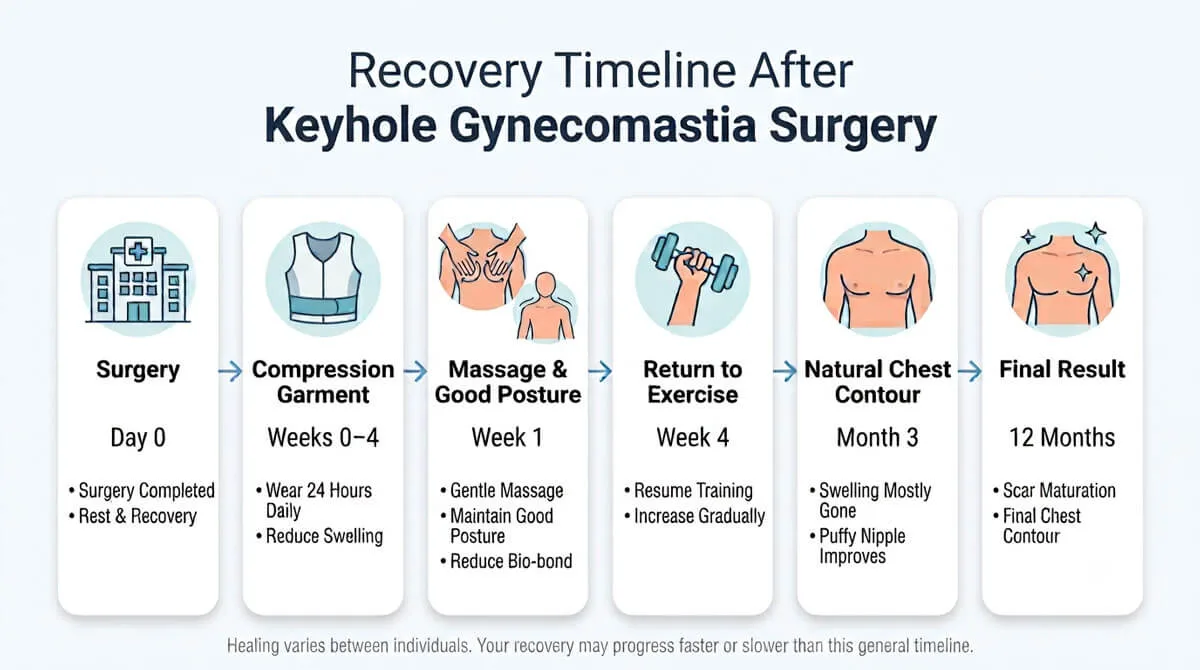
Typical recovery milestones after keyhole gynecomastia surgery. Healing may progress faster or slower than this general timeline.
After Surgery Checklist
Rest and Protect the Chest
Rest comfortably and avoid excessive arm movement, heavy lifting, or unnecessary pressure on the chest.
- Walk indoors for a few minutes several times during the day.
- Take all prescribed medications as instructed.
- Start with soft, easily digested food.
- Drink enough water after recovering from sedation.
- Do not open or remove the main dressing yourself.
Fluid Leakage May Occur
A small amount of blood-tinged or watery fluid may leak from the small liposuction openings during the first day. This is usually residual tumescent fluid and is not necessarily a sign of active bleeding.
- Reinforce the area with clean sterile gauze if needed.
- Do not repeatedly open the dressing to inspect the wound.
- Contact Evita Clinic if the dressing becomes rapidly soaked with fresh blood or the chest swells suddenly.
Showering
Showering may be allowed 1–2 days after surgery if waterproof dressings have been applied and our medical staff has approved it.
- Use lukewarm water.
- Do not scrub or rub the incision area.
- Gently pat the chest dry after showering.
- Replace any simple dressing as instructed.
- Avoid baths, saunas, hot tubs, swimming pools, and public baths for at least 4 weeks or until the wound is fully healed.
Waterproof Dressing and Sponge Pad
Waterproof dressings are generally used during the first several days. Some patients may also receive a sponge pad around the areola to provide more focused compression.
- Use the waterproof dressing for approximately 5 days unless instructed otherwise.
- Use the sponge pad around the areola for approximately 7 days when prescribed.
- Do not continue using the sponge pad longer than instructed.
- Contact the clinic if the pad causes severe pain, skin discoloration, numbness, or excessive pressure.
No Smoking
Avoid cigarettes, e-cigarettes, vaping, hookah, nicotine products, and secondhand smoke. Nicotine reduces blood flow and may increase the risk of delayed healing, skin problems, infection, and poor scar quality.
Compression Garment
Wear your compression garment for a total of approximately 4 weeks unless Dr. Jeon gives different instructions.
- First 2 weeks: Wear it approximately 24 hours a day, removing it only for showering and garment care.
- Next 2 weeks: Wear it approximately 12 hours a day.
- The garment should feel supportive but should not cause severe pain, persistent numbness, breathing difficulty, or skin discoloration.
- Make sure the fabric is smooth and does not create deep folds over the chest.
For detailed instructions, please review: Compression Garment Guide
Massage and Good Posture
After the wound and swelling have been checked by our medical staff, gentle massage may begin. The tissue beneath the areola can temporarily become firm or attached during healing. At Evita Clinic, this is often described as “bio-bond.”
Gentle massage may improve skin mobility, soften firm tissue, support circulation, and help the chest settle more smoothly.
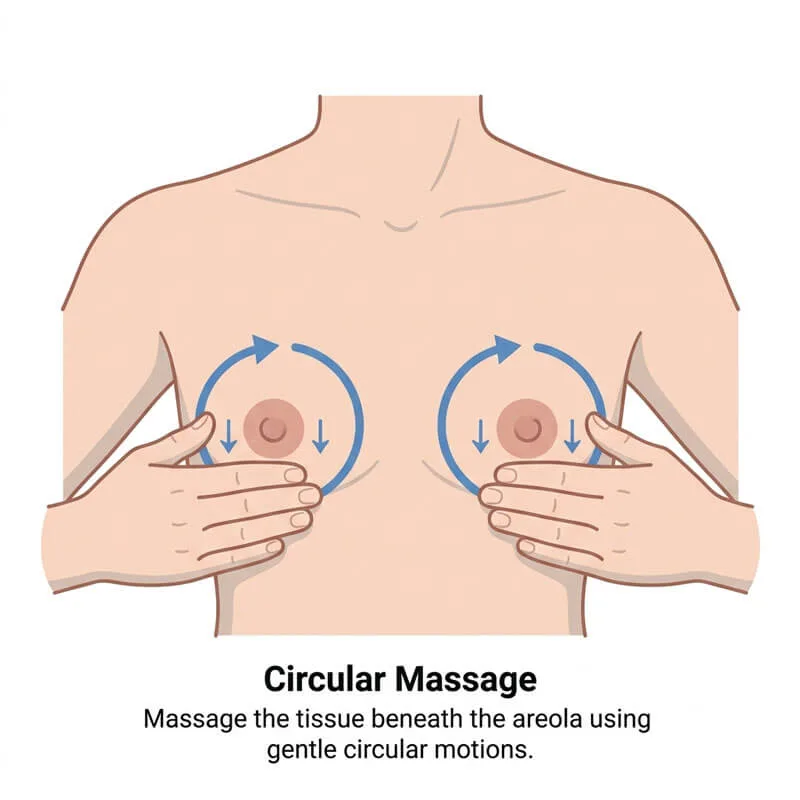
Use slow circular movements around and beneath the areola only after the wound has been checked and massage has been approved.
- Use the flat surface of your fingers rather than pinching the skin.
- Massage slowly around and beneath the areola.
- Apply gentle pressure toward the chest wall.
- Do not massage an open wound, active bleeding, increasing redness, or a painful swollen area.
- Stop and contact Evita Clinic if massage causes significant pain or increased swelling.
Good posture is equally important. Many patients instinctively hunch forward to protect the chest, but remaining bent forward may increase stiffness, reduce shoulder mobility, and contribute to skin folding or tissue adhesion.
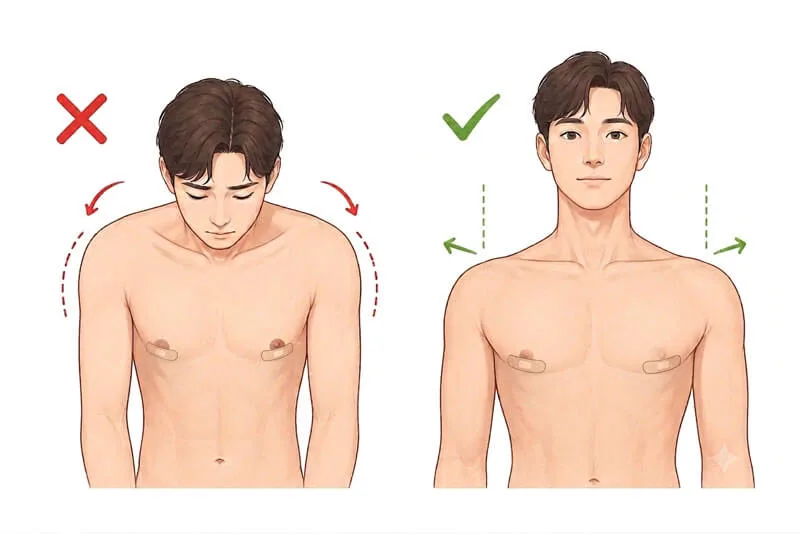
Keep your back upright, your head facing forward, and your shoulders relaxed rather than rounded forward.
- Sit and stand with your back as straight as comfortably possible.
- Keep your shoulders relaxed rather than forcefully pulled backward.
- Avoid remaining hunched forward for long periods.
- Gradually restore normal shoulder and chest movement.
- Do not forcefully stretch the chest during early healing.
Exercise and Weightlifting
Exercise and weight training may gradually resume after approximately 4 weeks and after approval from Dr. Jeon.
- Begin with light resistance.
- Increase the intensity gradually.
- Lower-body exercise may be easier to resume before heavy chest training.
- Stop if you develop chest pain, increasing swelling, or pulling around the incision.
- Heavy chest exercise should be resumed more cautiously than ordinary daily activity.
Food and Daily Activities
- Begin with soft, easily digested food after surgery.
- Most normal foods may be resumed as tolerated.
- Avoid alcohol during early recovery.
- Reduce excessively salty foods if swelling is significant.
- Light walking is encouraged from the day after surgery.
- Avoid lifting, pushing, pulling, or carrying heavy luggage during early recovery.
- Dragging light wheeled luggage may be possible, but avoid straining the chest and arms.
Normal Healing Changes
Your chest will not look final immediately after surgery. Swelling, firmness, temporary asymmetry, and contour irregularities are common during the healing process.
- Swelling and bruising
- Temporary puffiness of the nipple or areola
- Firmness beneath the areola
- Small lumps or uneven areas
- One side healing faster than the other
- Numbness, tingling, itching, or brief nerve sensations
- Temporary dimpling, skin folding, or wrinkling
- Bio-bond or tissue adhesion beneath the skin
Most swelling and firmness gradually improve over several weeks to months. Skin contraction and chest contour refinement may continue for 6–12 months.
Frequently Asked Questions
Is swelling normal after gynecomastia surgery?
Yes. Swelling, firmness, bruising, and mild asymmetry are expected during early recovery. One side may remain more swollen than the other for several weeks.
Why does my nipple still look puffy?
Temporary swelling, scar tissue, bio-bond, or incomplete skin contraction may make the nipple or areola appear puffy during early healing. This often improves gradually as swelling decreases and the skin contracts.
What is bio-bond?
Bio-bond is a practical term used at Evita Clinic to describe temporary firmness, adhesion, or scar-like tissue beneath the skin after surgery.
It often softens gradually with time, appropriate massage, warmth, stretching, normal movement, and exercise.
When can I begin massage?
Gentle massage may generally begin around 1 week after surgery, but only after the wound and swelling have been checked and massage has been approved by our medical staff.
How long should I wear the compression garment?
In general, wear it 24 hours a day during the first 2 weeks and approximately 12 hours a day during the next 2 weeks. Dr. Jeon may adjust this schedule depending on your swelling and skin condition.
When can I shower?
Showering may be allowed 1–2 days after surgery when waterproof dressings are in place. Follow the instructions given during your postoperative visit.
When can I sleep on my side?
Sleeping on your back is recommended during early recovery. Side sleeping may resume gradually when swelling has improved, the wound is stable, and pressure on the chest is comfortable.
When can I return to work?
Light desk work may often resume within several days. Physically demanding work involving lifting, pushing, pulling, or repetitive upper-body movement requires more recovery time.
When can I return to the gym?
Walking is encouraged immediately. Weight training, push-ups, and strenuous chest or upper-body exercise should generally wait at least 4 weeks and should resume gradually.
Can gynecomastia come back?
Removed gland tissue does not normally regenerate. However, substantial weight gain, hormone changes, use of certain medications or anabolic steroids, or residual tissue may affect the future chest contour.
When will my chest look natural?
Most swelling improves during the first several weeks, but firmness, puffiness, skin contraction, and chest contour may continue improving for 3–6 months or longer.
When will the scars fade?
Early scars may appear red, dark, or firm. They usually soften and fade gradually over 6–12 months, although complete scar maturation may take longer.
When can I fly home?
International patients should remain in Korea for the recommended follow-up period. During long flights, walk regularly, stay hydrated, move your ankles and legs while seated, and avoid lifting heavy luggage.
When Should I Contact Evita Clinic?
- Rapidly increasing swelling on one side
- Severe pain not relieved by medication
- Persistent or rapidly increasing bleeding
- High fever
- Increasing redness, warmth, or spreading inflammation
- Yellow or foul-smelling drainage
- Wound separation
- Darkening, blistering, or poor circulation of the nipple or skin
- Difficulty breathing or chest tightness
- Any sudden or concerning change in chest shape
Important Note
Recovery after gynecomastia surgery requires patience. Temporary swelling, puffiness, firmness, unevenness, and bio-bond are common parts of the healing process.
Follow the individualized instructions provided by Dr. Jeon and the Evita Clinic medical team regarding dressings, compression, massage, posture, scar care, and exercise.
Still Have Questions?
If you are unsure about swelling, wound care, compression, massage, posture, exercise, travel, or any change in your chest, please contact Evita Clinic. Our medical team will review your condition and provide individualized guidance.